How to Deal With a Narcissist Using the Silent Treatment
When someone you love suddenly shuts down, ignores you, or pretends you don’t exist, it feels unbearable. The silence itself becomes a form of noise: filled with anxiety, self-doubt, and confusion. It can be a very draining and painful experience. If you’re experiencing this with a narcissist, it’s not a misunderstanding or “time-out.” It’s a form of emotional control.
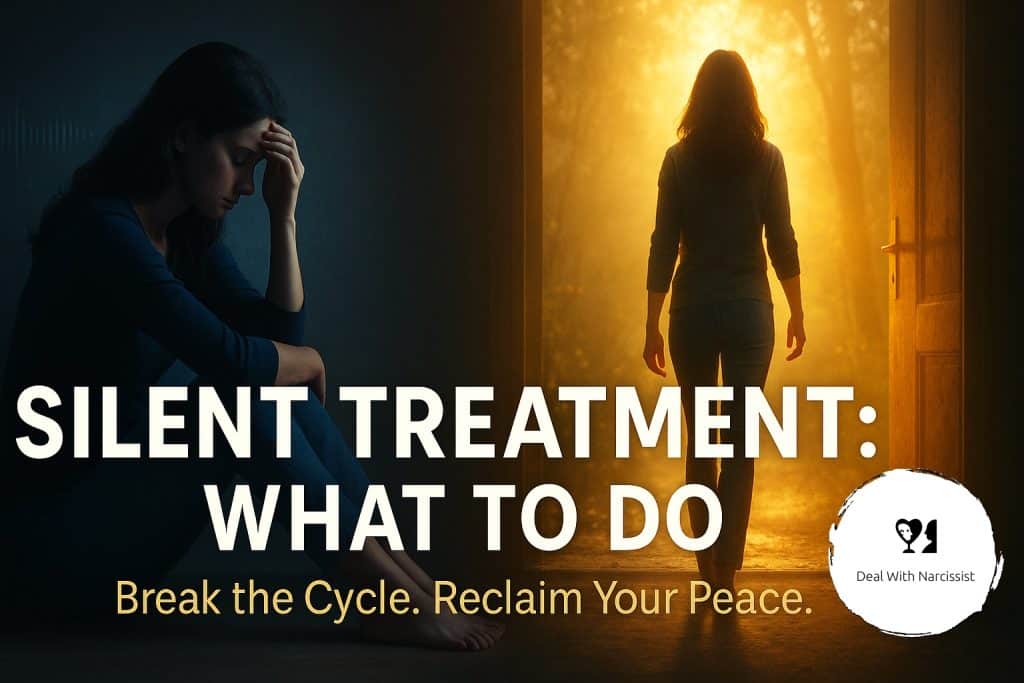
The silent treatment is one of the narcissist’s most common manipulation tactics, and understanding how it works is the first step toward protecting your peace. In this in-depth article, we’ll explore what the silent treatment really is, why narcissists use it, how it shows up, and how to respond in a way that protects your energy and rebuilds your calm.
What the Silent Treatment Really Is
The silent treatment is a form of emotional abuse some narcissists use to control others. It’s a passive-aggressive tactic meant to create confusion, guilt, and dependence. When communication stops, the goal isn’t resolution — it’s power.
Silent treatment is a way to gain control through avoidance, silence and emotional disempowerment. You become trapped in manipulation instead of healthy communication. Sadly, compassion, love and empathy disappear in this dynamic. When given the silent treatment it basically tells you that someone doesn’t respect you, is manipulating you, or is unable to communicate in a healthy way.
As with most narcissistic behaviour, it has similarities to (excess) behaviour of children. For example, when children are angry or embarrassed they can use the silent treatment to get space or to push your buttons. They then might feel a form of power or control over you, which fulfills the human need of significance. For a child, it’s normal to show this kind of behaviour sometimes but for an adult clearly, it’s not. A narcissist may choose this immature method deliberately, often without limits to how long or how intensely they use it.
The use of the silent treatment doesn’t necessarily mean that someone is a narcissist or a manipulator. It can also be a sign of someone that is emotionally immature. Someone might fear showing emotions or simply not know how to handle conflict in a healthy way. No matter what the reason is for using the silent treatment, it’s never a healthy way of communication.
A person with healthy emotional regulation will let you know something if they need some time to gather thoughts and tell you they will get back to you. They will say they need some space before they can talk about it, tell you they have trouble to open up about something or suggest to talk about it another time. This is not similar to the silent treatment because it’s asking for space which is healthy communication. Understanding the difference between healthy space and manipulative silence helps you recognize when you’re being controlled; and when it’s time to protect your peace.
Reasons Why Narcissists use Silent Treatment (5 common motives)
Once you can clearly recognize what the silent treatment really is, the next question becomes why a narcissist uses it. Understanding their motives helps you detach emotionally instead of taking their behaviour personally. While every situation is different, most narcissists use the silent treatment for one or more of the following reasons: to punish, to regain control, to devalue, to avoid responsibility, or to seek new supply.
1. Punishing You
You could have frustrated them, hurt their ego or you might just not do what they expect or want you to do. They might think they are losing control over you. The narcissist then wants to teach you a lesson. If this is the reason it’s a direct response to something you did or said.
It could be that you set a boundary, you said ‘no’ to something, or even something small as you didn’t answer them calling you. The latter would mean they want you to always be available for them. To solve this they seek an emotional response from you by giving the silent treatment. They hope you try to make contact, ask for forgiveness or become mad or emotional.
2. Regain Control and Power
In arguments or in a relationship a narcissist might feel like they are losing control over the situation or the relationship. Some narcissists are great at gaslighting and manipulation in communication and could have less tendency to use the silent method. Other narcissists need this method to gain control because they aren’t able to do it in other ways. And some narcissists might use it for the sake of doing it (‘because I can’) and use both gaslighting and the silent treatment.
The aim will be to make you feel powerless and to control your behaviour. A narcissist feeds off the emotional reaction you might have in response to the silent treatment. This is all narcissistic supply.
3. To Devalue You
Another possible reason is that they want to show that you are not worth their energy or response. You might not be their main concern at that time and they use the silent treatment to devalue you. By devaluing you their own value increases in their twisted mind. They can try to isolate you, cause loneliness, make you feel you’re the one to blame and/or that you did something wrong.
Devaluing is part of the narcissistic abuse cycle, which is a repetitive cycle consisting of stages of idealization, devaluing, and discarding. I wrote an article explaining these stages of the narcissistic abuse cycle if you want to read more about it.
4. Avoiding Responsibility for Actions
The silent treatment could also be used to avoid responsibility for earlier actions. It could be a response to you wanting to speak about their behaviour or your relationship. By using the silent treatment the narcissist tries to avoid taking responsibility for the past. It’s a distraction when you possibly discovered their lies.
5. Gaining New Supply
There can be a very practical reason for the narcissist to use the silent treatment or disappearance, which is to gain new narcissistic supply. They use it to spend time with new victims. Sometimes they evolve and crave for new drama, excitement and supply.
If the new supply doesn’t work out they will try to come back like nothing happened. They can manage to do this often because of victims trauma bonding, having low self worth due to the abuse, having fears and being stuck in the web of control. I wrote an article about the web of control of a narcissist you can read here if you want to read more about this dynamic of creating a dependency on them and isolating you.
No matter which motive is behind it, the silent treatment always serves the same purpose: control through disconnection.
Recognizing these patterns is the first step. Next, let’s look at how this behaviour actually shows up in daily life, and the subtle forms it can take.
How It Shows Up: 6 Forms of Silent Treatment
There are a lot of forms of silent treatment which are all forms of disconnecting and ending communication in some way. It can be on a communicational level but also physically disconnecting or disappearing is a form of silent treatment. To start off and show the variety first, here are a few general examples of the silent treatment:
- Giving the cold shoulder and refusing to speak to you because you didn’t help with something.
- Ignoring you or only using one-word answers but not telling you what’s bothering them.
- Ignoring what you are saying and not listening or showing any attention to you at all.
- Ignoring you on your birthday. For example narcissistic family that can’t deal with the attention being directed at someone else.
- Showing a lack of touch or lack of affection.
- Disappearance without saying anything. And pretending everything is normal when coming back.
There are many forms and the extent to which the silent treatment occurs can differ. I will now go shortly into a few forms of the silent treatment used by a narcissist.
1. Stonewalling
When a conversation is shut down and someone refuses to address your concerns this is called stonewalling. It’s withdrawing to avoid conflict and it’s a form of abandonment. It’s like cutting off the oxygen to your emotions and feelings. This could happen, for example, if you want to discuss something that happened or your doubts about something in your relationship.
2. Lack of Touch and Affection
A lack of touch or lack of affection is behaviour that’s closely related to the silent treatment and arguably a form of silent treatment. It is a form of physical silent treatment. This is a way to starve the other person’s need for affection. It’s ignoring that there is any affection and creating more distance, as there is no way to connect. Lack of touch can go hand in hand with the silent treatment. It’s fully depriving the other person of care and attention.
3. Silent Treatment After a Breakup
You could have had a long marriage and even children with a narcissist and they still are able to brutally discard you like you never existed. A narcissist is capable of disposing of anyone and they will not give a damn about it. It’s the cruellest thing as you have put years of effort, love and devotion into your relationship or marriage. Sadly, it can happen and it will require a painful process of healing.
4. Everyday Silent Treatment
The everyday silent treatment is the more ‘regular’ silent treatment within the interaction with a narcissist, a relationship or marriage. It’s a manipulative game of simply trying to get narcissistic supply by making you (emotionally) respond, feel anxious, wonder and doubt. The aim is to trigger your deeper insecurities and thereby getting attention and trying to control you. If the silent treatment doesn’t work a narcissist can change their strategy and attack you for ignoring them. They can blame you for not connecting and mirror the problem so you get confused.
5. Narcissistic Sulking
Sulking could be seen as a form of silent treatment as well. The narcissist will be verbally quiet about being hurt, envious, frustrated or angry, but is openly showing these feelings nonverbally to you or others. A sulking narcissist is thus trying very hard to show their displeasure to you by their posture, facial expression, or body movements.
It’s quite similar to a pouting child and it’s a passive-aggressive method to gain narcissistic supply. Sulking seems to be mostly about revenge or punishing by making the victim ‘regret’ what they did or said.
As it’s very obvious unhealthy behaviour it’s not that effective when used often. The more intelligent narcissists, therefore, will prefer not to use ‘obvious’ sulking but will rather use more manipulative methods.
6. Silent Treatment at Times You Need Support
This is a very cruel and heartbreaking form of silent treatment. There might be a time when you were mourning or in a tough place. Some narcissists can specifically use these moments to pull away and emotionally abandon you.
They will not acknowledge your existence at these moments when you especially would need their support. It’s right when you need support and their love the most. They can even blame you for your behaviour of not being cheerful. It’s thus a very brutal form of silent treatment.
It’s because the narcissist doesn’t like the attention is with you and doesn’t care about the feelings of others. To support you a narcissist would have to be there for you and serve you. This doesn’t fit in their world which is only about them and lacks empathy.
Whether it’s cold silence, sudden distance, or the quiet withdrawal of affection, the result is always the same: you’re left confused, anxious, and searching for what went wrong. Understanding how the silent treatment appears on the surface is one thing, but its deeper impact often hides underneath.
Let’s explore what this behaviour actually does to you emotionally, and why recognizing that is such an important step in healing.
What it Does to You
We can conclude that the silent treatment used by a narcissist exists in many forms and is brutal and abusive behaviour. Personally, I don’t think it’s a subtle method but an obvious, brutal and immature method. You are treated like you no longer exist, which is painful. It results in anxiety, self-doubt and trauma bonds.
Silence can be very powerful when there is inequality in a relationship. This can be inequality in self worth and attention. If you’re in a place of self-doubt it will result in anxiety and you disconnect from yourself. In this ‘state’ you will think about all the scenarios of what happened and what you possibly did wrong. The unpredicability of connection and disconnection can result in a trauma bond, because of the dynamic of positive reinforcement vs. punishment.
Once you see how deeply the silent treatment affects your sense of safety, it becomes easier to understand why it’s such a powerful manipulation tool.
But awareness is also the beginning of freedom. The more clearly you can recognize the signs, the less control this behaviour will have over you.
Let’s look at how to identify when the silent treatment is happening; and how to trust what your intuition is already telling you.
How to Recognize the Silent Treatment From a Narcissist
Before being able to decide what to do, you need to know whether you’re really dealing with a narcissist using the silent treatment. Therefore it’s important to first recognize what’s going on, analyze what happened and evaluate this. I will go into this and then I will share three phases on how to deal with a narcissist using the silent treatment.
1. Recognize What is Going On
This is an important first step. Write down their behaviour and also check your own behaviour. It’s good to ask yourself what happened and what might have caused the silent treatment without judging. Don’t spend too much time thinking about this as it might go into repeating thoughts and worrying. If you feel like you did nothing wrong after your reflection you can trust this feeling.
Question your intuition whether you did something wrong or did something offensive. When dealing with a narcissist you must trust your intuition. It can be hard to recognize you are not the one to blame because of earlier emotional abuse. This is because a narcissist can make normal behaviour abnormal by responding abnormal, and the other way around.
Because you are here reading this, it’s more likely that the other person is showing an abnormal reaction to normal behaviour such as saying no or setting a boundary. Remember that the silent treatment is an abnormal method in itself. Know that even if you did do something wrong, the silent treatment is an immature way of responding and using it should be apologized for. A narcissist will not apologize and possibly deny it even happened (gaslighting).
2. Analyze What Happened and Evaluate
What was the trigger for the other person and what happens to you when someone is using the silent treatment and is neglecting you? The chance is the silent treatment hurts more when you experienced similar experiences like this in childhood. These old feelings can make it very painful, fearful and make you anxious.
It can be helpful to label these feelings if the experience triggers memories. Try to be kind and compassionate to yourself during this step.
3. Decide Whether it’s Acceptable Behaviour for You
You don’t have to allow the silent treatment. Do you want to stay in a relationship with someone actively using this method? Does this meet your standard of respect and treatment of each other? You can own your reality and stand for your truth. If you set a boundary and someone will punish you with the silent treatment, you can decide it’s not a relationship you want to continue.
You want to able to set boundaries and you can decide it’s not okay to be punished for that. I’m aware this is ‘simple’ but not easy to do when in this situation. I will go into this more. For now, know that it’s possible.
How to Respond to the Silent Treatment
I will now to go into three ‘phases’ on how to deal with narcissists using the silent treatment.
The best way to deal with a narcissist is to go no contact in order to save yourself and protect your energy. If you are able to do this right away, the best time always is now. If you need more time it’s important to not take responsibility for the behaviour of others and possibly learn about the grey rock method for dealing with narcissists when going no contact is not an option (right away).
1. Don’t Take Responsibility for the Behaviour of Others
This is an important phase and principle for handling a lot of manipulative behaviour. It’s about not taking responsibility for the behaviour of others. This is a very helpful belief or principle to learn in life. If someone is using the silent treatment, it’s a form of unhealthy communication. There are healthy ways to talk about problems and feelings instead of this person deciding to use immature and manipulative methods.
Don’t believe it’s your fault someone is using the silent treatment. It’s wrong to use the silent treatment to punish or control you. There isn’t any excuse or good reason for using it. A narcissist merely uses the method to control and not to work things out. So there isn’t any need to feel responsible for someone else using the silent treatment.
If you did something to hurt someone you can think about this and take responsibility for your own behaviour. Even if you really hurt someone or made a mistake, it isn’t an excuse to use the silent treatment. A person with healthy emotional regulation will at least tell you they need some time or space. Or at least quickly afterwards. If they don’t acknowledge it at all, this is a major red flag!
Feeling responsibility and trying to fix the situation as a response to the silent treatment would be rewarding this behaviour with your attention. It confirms they are in control. The other person created a distance, which means it’s not up to you to close it. The silent treatment is not acceptable behaviour but a manipulative power game.
Name the Experience (Healthy Communication Pattern)
You don’t have to respond to someone using the silent treatment but it can be useful to name the experience for yourself. Possibly try the next pattern, but know that when dealing with a narcissist there is no point in actually saying it to them. You can, however, say this to yourself as it might help with putting the responsibility back to where it belongs. It confirms the principle of not taking responsibility for the (manipulative) behaviour of others.
You could use the next pattern to name the experience:
- You name the fact of what is happening.
- You tell how it makes you feel.
- You suggest how to go forward.
This can look like the following:
‘I noticed you’re not responding to me anymore. Seeing this makes me feel anxious. I would like to know why you give me the silent treatment but only you can break this behaviour. I understand something is bothering you and I hope you know you can talk about it whenever you are able or ready to open up. I will give you space now but I will not take responsibility for your behaviour because I prefer open communication.’
The above example shows how you can put to words that you won’t take responsibility for the silent treatment being used. You consciously put the responsibility back to the person using the silent treatment. You emphasize that you prefer communication and you are not responsible for someone using it. You could say it to yourself so you know you’re not responsible for this behaviour. Believe what you say with your whole body, and it will be very powerful to yourself.
When You Respond With Communication
If you do decide to go into communication about the silent treatment the best method is to be as adult as possible, such as using the above communication pattern. If you start with blaming or use a lot of emotion this might be exactly what the narcissist wanted. Therefore, put the responsibility at the narcissist and then observe the response. You want to show there is no control or power being regained and you show boundaries.
The question remains whether it’s useful to actually say it to the narcissist. The problem is that adult interaction is impossible with someone that only shows manipulative behaviour. There is no basis to connect on. In my experience, it will thus never be useful to go into interaction as it only allows many more manipulation tactics such as gaslighting, mirroring and hoovering. It only results in pain, confusion and your energy being drained. So I advise only using this method for your inner self to help you not feeling responsible and start disengaging.
2. Disengage (Grey Rock)
It’s not always possible to go no contact right away which means you need to interact with the narcissist. You could start disengaging and use a form of the grey rock method. I have written an in-depth article about the grey rock method which you can read here. This is relevant when you going no contact with a narcissist is not an option (right away). When going into interaction you reward the narcissist by engaging with them. You can appear relaxed/positive or just very neutral and unappealing as a grey rock.
Here are a few things certainly not to do in response to the silent treatment:
- Don’t beg for anything. Don’t beg for their attention, love or communication.
- Don’t apologize for something you didn’t do for the sake of stopping the silent treatment.
- Don’t cry or show your hurting to the abuser. Don’t try to reason with the abuser. They know what they are doing.
- Don’t try to make the peace and make it go away. Don’t behave like you have to make something right and pamper them. It’s not your mess to clean up.
3. Use the Opportunity and Go No Contact
We already know that going into real communication is in a way pointless when dealing with a narcissist. You can use communication to set boundaries and possibly create some space within the interaction with the narcissist. This is however still relative to the control that the narcissist has over you. You might have a room to yourself but the narcissist still owns the house.
Don’t fool yourself that you are not in the web of control of the narcissist. Eventually, the only way to stop this control is by going no contact. You could thus use the opportunity to go no contact. If your intuition is clear about the situation: next time you are getting the silent treatment, you could use that time to make it permanent.
Reflect on how it would be. Does this person bring you energy or drains your energy? If you’re dealing with a narcissist, I can tell you it will be draining. You might feel less like yourself, have more doubts and even be gaslighted. A form of gaslighting would be that the narcissist using the silent treatment might act as nothing happened and act like everything will just go on how it was before when going into contact again. This is a big red flag!
I wrote an article about gaslighting if you want to read more about this specific kind of manipulative behaviour. It can be a lifesaver to become aware of this form of manipulation.
You can choose a certain level of respect and communication you want. It’s a boundary you can set. A narcissist will not meet those standards. You don’t want to hold onto someone that is abusive and whose love is conditional. I understand you do feel the love but that’s the love this person brought out from within yourself. It shows how much you can give and love someone, which is beautiful!
What if I Can’t Accept a Narcissist Out of My Life?
There might be situations where you can’t accept the thought of not having contact with a narcissist. You might have an adult daughter or son who is narcissistic or has the tendency to show narcissistic behaviour. You possibly have grandchildren in your life that you want to see and therefore you would have to have contact with your narcissistic daughter or son.
Self worth and confidence is the key to protecting your boundaries and not taking responsibility for the behaviour of others. Being independent and enjoying your own company are strong antidotes to manipulative behaviour. You don’t have to walk on eggshells if you don’t want to. So work on yourself, your self worth and setting boundaries and this will help you to protect your energy. You can read this article about how to rebuild self worth after narcissistic abuse for tips on how to work on your self worth.
Frequently Asked Questions About The Silent Treatment
1. What is the silent treatment?
The silent treatment happens when someone deliberately withdraws communication, attention, or affection to punish, control, or confuse you.
2. Why does a narcissist use the silent treatment?
A narcissist may use silence to punish you, regain control, avoid accountability, or focus on new sources of attention (supply).
3. What is the difference between the silent treatment and going no contact?
The silent treatment is used and intended as a manipulation; going no contact is a healthy, conscious choice to protect your peace without aiming to manipulate or control the other person.
4. Is the silent treatment emotional abuse?
Yes. Silence becomes abuse when it’s used to punish or control instead of communicate boundaries or calm.
5. How can I deal with a narcissist’s silent treatment?
Don’t (emotionally) respond, thus don’t chase, beg, or explain. Stay calm, set clear boundaries, and disengage. Clearly see it’s their behaviour and remind yourself that you can’t control the behaviour of others. Use the time to reflect and rebuild your self-trust.
Learning how to respond to the silent treatment is an act of self-protection, but healing goes even deeper than knowing what to do. Once you’ve stopped reacting and started setting boundaries, the real work begins: turning your attention inward. This is where freedom grows; not from controlling the narcissist’s behaviour, but from no longer letting it define your peace.
Let’s explore how to shift your focus from their silence to your own voice, and how to rebuild the calm that belongs to you.
Breaking Free From the Narcissist
We can conclude the (constant) use of the silent treatment is a massive red flag and a deal-breaker for most. If it’s a deal-breaker and you take action, it means you stand for how you think communication and respect should be in a relationship. This is great! The problem is that most do feel that it should be a deal-breaker, but to really get out of the relationship is not that easy when dealing with a narcissist. A lot of victims break up several times before the final breaking up.
Narcissists seem to go for you when you’re vulnerable or work hard to make you vulnerable. This means playing all kinds of manipulative games to reduce your self worth, fade your boundaries and create self-doubt. It’s a trap that makes you cross your boundaries and ignore your intuition. From this position, it’s obviously very hard to escape a narcissist and it takes a lot of courage to break free.
If you want to read about what to expect when you break up with a narcissist you can read this article. A narcissist might try to win you back when you seem to take a distance and go no contact. It’s essential to learn more about this behaviour and to learn how to walk away from people that drain your energy.
Shifting Your Attention From the Narcissist to Yourself
A narcissist will not give any explanation for their behaviour. If you are dealing with a narcissist, prepare to never have any explanation or an answer to why they behaved as they did. Don’t blame yourself if you are a victim of a narcissist. Start reading more about narcissism and try to work on shifting attention from the narcissist to yourself. You need to recover and heal. It starts with recognizing and trying to be kind to yourself.
Focus on positive energy and kindness. Focus on what brings you joy. Enjoy time with people that show real love and kindness, enjoy being in nature or doing whatever hobbies you like. Take care of yourself and be kind to yourself. Try to shift your attention from the narcissist to yourself. You deserve a healthy relationship with healthy communication in which you are seen and treated with respect. You deserve someone caring about your feelings and showing kindness, love and compassion. I hope you know this and I hope you know you are enough!
You can start your path by trying to give yourself what you deserve and start moving with small steps in the right direction! If you want guidance in this process of reclaiming your power, I gently recommend learning more about my book Recognition Code for Narcissism. It’s a roadmap how to recognize manipulation, set boundaries, break free emotionally and reclaiming your sense of self. Written from experience with kindness and compassion 💜. I wish you strength and more kindness in the future!
📚 Learn more about the full e-book →
My daughter is giving us the silent treatment. Your article was very enlightening as to her possible motivations, and how to deal with her.
I am a single parent of three children and my ex partner who knows I suffer from extreme anxiety depression and low self esteem , when I try and discuss arrangements for the kids with him he shuts any conversation down , shouts over me and blocks me so that nothing is ever sorted out . He had done this for 7 years now and recently when I informed him of a problem with our 16 year old he shouted over the whole conversation , hung up and blocked me completely., I have no control in my life and beg someone to help me understand this behaviour
Hi Julie, I’m sorry about your experience. It’s very disturbing behaviour and sadly, you have no control over the behaviour of this person and might not be able to understand it. I think it would be great if you could find some local support/help or a therapist, in order to try to find and explore the decisions you do have control over. Know that you have a lot of strength within! I wish you strength and more kindness in the future!
Thank you so very much for writing this article and the others that I will read later! I was emotional while reading the article which will help me through this difficult time. I’ve been dealing with a husband that has stonewalled me for as long as I can remember, for sure more than 33 years. One time it was for more than 6 weeks. Now I have a daughter that is doing the same to her husband, myself and our other daughter, along with her husbands family members. She seems to take a lot of pride in her stonewalling abilities! Stonewalling is so cruel and it has sucked the life out of me! I don’t know when last I really felt happiness! The other day, I found myself researching/googling “What is happiness”. Anyway, THANK YOU once again!