Narcissistic Triangulation: What It Is, Why They Do It, and How to Stay Grounded
Triangulation often doesn’t look dangerous at first. It can start with a small comment, a comparison, a story that makes you pause for a second. But slowly, you notice you’re feeling uneasy around someone you normally trust. You catch yourself wondering why your relationships feel tense, or why you’re explaining yourself more than usual. You sense something is off, but you can’t quite name it.
This is how triangulation works. It pulls you into doubt before you even realize what’s happening.
A narcissist uses triangulation to create confusion, insecurity, or distance between you and the people who matter to you. Instead of speaking with you directly, they bring in a third person, such as a friend, a sibling, a coworker, or a new partner, and shape the story through them. The goal is simple: control the narrative, control your emotions, and in the end, control you.
Triangulation affects more than your thoughts. It affects your energy, your confidence, and your sense of connection with the people you normally trust. You might catch yourself second-guessing your intuition, doubting someone you love, or feeling strangely isolated. That’s not because you’re weak or naive. It’s because this tactic is designed to unsettle your mind and slowly shift your sense of reality.
This article is here to bring the truth back into focus. You’ll learn what narcissistic triangulation is, why it’s used, how it affects your sense of self, and how to step out of the dynamic with clarity and strength. The goal is not to diagnose someone, but to understand the behaviour so you can recognize manipulation early and protect your peace.
If you want to see how triangulation works in real situations, I also made a separate article with six examples. It gives you a clear picture of what this tactic looks like in everyday life so you can spot it faster in your own situation.
You deserve relationships built on honesty, not manipulation. My hope is that you feel less confused, more grounded, and more connected to your own truth by the time you finish reading. You deserve clarity, calm, and relationships that feel safe.
What Is Narcissistic Triangulation?
Triangulation happens when someone avoids speaking with you directly and instead brings in a third person to influence the situation. Instead of addressing an issue with you, they shape the story through someone else. It creates a triangle instead of a straight, honest line of communication. A narcissist uses this tactic with intention. The goal is to:
- confuse you
- create doubt
- change how you see yourself or someone close to you
- gain control over how the story is told
Triangulation can look subtle at first. It might be a small comparison that makes you feel “less than,” a comment about someone else’s opinion of you, or a story told in a way that shifts your perspective. But over time, these small moments build pressure. You start to question your judgment. You may begin to pull back from people you normally trust. You might feel strangely dependent on the narcissist to “explain” what’s going on.
This tactic works because it targets your sense of safety and connection. When trust between you and someone important becomes shaky, you feel more vulnerable. And people who rely on control take advantage of that vulnerability.
Triangulation is also connected to other manipulation patterns you may already know, like gaslighting, provoking jealousy, creating rivalry, or playing the victim. It’s one of the tools a narcissist uses to keep attention, sympathy, or power flowing back to them. Understanding the tactic doesn’t mean you have to diagnose anyone. What matters is recognizing the behaviour so you can stay grounded in your own truth and protect your energy.
How Triangulation Shows Up in Daily Life (Short Overview)
Triangulation doesn’t always look dramatic. Often it shows up in small, subtle shifts that are easy to miss at first. A comment here. A comparison there. A story about what someone supposedly said. Little by little, the narcissist places themselves in the middle and shapes how you see other people, or how other people see you. Here are a few common patterns:
- Subtle comparisons: They mention someone who is “doing things right” to make you question yourself, or to push you into insecurity.
- Shaping the story through a third person: Instead of speaking with you directly, they tell you what someone else “thinks” or “said”. Often it’s exaggerated or completely fabricated.
- Using other people as pressure: They might claim that “everyone agrees” with their point or that others are worried about your behaviour. This creates emotional pressure and lowers your confidence.
- Creating distance between you and someone you trust: They plant doubts, twist comments, or stir unnecessary conflict so you become less connected to people who would normally support you.
These patterns can slowly make you feel unsure, isolated, or dependent on their version of events. Recognizing these small signs early can help you step out of the dynamic before it becomes more damaging.
The Triangle Roles (A Short Explanation)
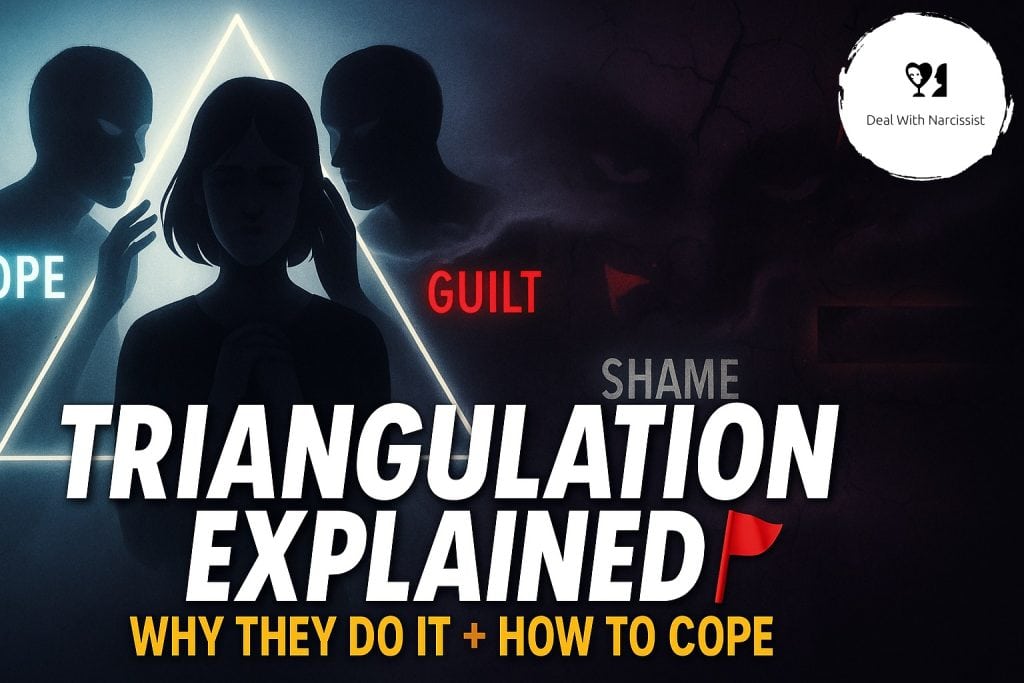
Triangulation is named after the three positions a narcissist creates. These roles shift depending on the situation, but the structure stays the same:
- The Persecutor: This is the person who drives the conflict. In narcissistic triangulation, the narcissist usually takes this role while presenting themselves as the victim. They create tension, fuel insecurity, and control the story.
- The Rescuer: This is the third party the narcissist pulls in. It can be a friend, a family member, a coworker, or even someone who doesn’t know they’re being used. The rescuer becomes the “ally” who supports the narcissist’s version of events, often without realizing they’re being manipulated.
- The Persecuted: This is the person being targeted: the one the narcissist wants to destabilize, isolate, or control. Their normal emotional reactions are often twisted and used as “proof” to support the narcissist’s story.
These roles aren’t about truth. They’re simply positions in a manipulative setup. Understanding the triangle makes it easier to step out of it and stop playing a part you never asked for.
Why Narcissists Use Triangulation
A narcissist doesn’t use triangulation by accident. For them, it’s a strategy. It helps them control the story, influence emotions, and keep people off balance. When you understand the purpose behind it, the behaviour becomes much easier to spot and name. Here are the core reasons a narcissist relies on triangulation:
1. Control and emotional leverage
Triangulation lets them shape how people see each other, including how you see yourself. If they can make you doubt your instincts or someone in your support system, they gain more power over the situation. Confusion creates vulnerability, and vulnerability makes control easier.
2. Devaluing without taking responsibility
Instead of saying hurtful things directly, they bring someone else into the picture. They might compare you to another person, mention what “everyone” supposedly thinks, or share a comment out of context. This allows them to criticize you while claiming they’re “only being honest” or “just passing on information”.
3. Gaining narcissistic supply
Every emotional reaction you have, such as jealousy, fear, insecurity, anger, feeds their sense of importance. Triangulation is designed to provoke reactions. The more destabilized you feel, the more attention, energy, and emotional investment they receive.
4. Creating dependency
Triangulation isolates you. When you trust your own judgment less or feel uncertain about the people you normally rely on, you become more dependent on the narcissist for information, clarity, or emotional reassurance. This dynamic benefits them and keeps you from stepping away.
5. Recruiting allies
A narcissist wants validation. They want people to believe their version of events. Triangulation helps them gather supporters; sometimes without those supporters realizing they’re being used. These “flying monkeys” increase the pressure on the victim and reinforce the narcissist’s story.
6. Protecting the false image
Triangulation helps them maintain the role they want to play: the victim, the hero, the misunderstood partner, the loyal friend. By controlling what others hear, they protect their image and direct blame away from themselves.
How Triangulation Affects You Emotionally
Triangulation doesn’t only distort how you see the narcissist. It slowly changes how you see yourself, your relationships, and even your own instincts. Most people don’t notice this right away. It creeps in. It pulls you into doubt, tension, and emotional exhaustion without you realizing something external is shaping your inner world.
Below are the core ways triangulation affects you. These aren’t signs of weakness. They are predictable effects of a tactic designed to confuse and destabilize.
1. You start doubting what’s true
When someone controls the story and filters communication through themselves, your mind tries to fill in the blanks. You begin replaying conversations, overthinking small moments, or feeling unsure about things that used to feel clear. That confusion is part of the tactic. It makes you easier to influence.
2. You become disconnected from people you normally trust
A narcissist often tries to shift how you see others. They plant doubts, twist small situations, or frame people in negative ways. Over time you may pull back from friends, siblings, or coworkers because things feel “off.” This isolation makes you more dependent on the narcissist without noticing the shift.
3. You get pulled into emotional comparison and competition
Triangulation pushes you into a mental battle you never agreed to join. You might feel the urge to prove your worth, defend yourself, or “fix” how you’re seen. This drains your energy and keeps your attention locked on them instead of your own life.
4. Your self worth takes a hit
Triangulation works because it targets something deep: the human wish to feel secure, valued, and understood. Being compared, doubted, or questioned over and over can make you wonder if something is wrong with you. It isn’t. The dynamic is designed to erode your confidence so you stay in the cycle.
5. Your nervous system becomes tense and alert
The constant second-guessing, emotional pressure, and subtle threat of being “replaced” or misunderstood can put you in a state of chronic alertness. Your body feels unsafe even in calm moments. You might feel restless, worried, or strangely guilty without knowing why.
6. You begin losing connection with your intuition
Intuition gets quieter when someone keeps pushing a false story at you. You stop trusting your inner signals because you’re busy trying not to upset the narcissist or hoping to avoid more conflict. This “inner distance” is one of the most painful effects.
The good news is that once you start seeing the pattern, your clarity returns. You reconnect with yourself. Your instincts restart. You begin noticing the manipulation instead of absorbing it. Awareness is the first step out of the triangle.
The Game of Truth (Why Triangulation Feels So Personal)
Triangulation hurts in a way that’s hard to explain to someone who hasn’t lived through it. It’s not just the comments or the comparisons. It’s the feeling that your reality is slowly shifting. You sense you’re losing your footing, even though you’re trying to stay rational and grounded. This happens because triangulation isn’t only a manipulation tactic. It’s a direct attack on your sense of truth.
A narcissist tries to control the narrative, which means they try to control the meaning of events, the motives behind actions, and the emotional tone of relationships around you. When someone keeps adjusting the “story,” even in subtle ways, your mind works overtime to reconcile what you feel with what you’re being told. That inner conflict is exhausting.
Triangulation feels so personal because it targets three core parts of you:
1. Your need for clarity
Most people want to understand what’s going on so they can respond in a healthy way. Triangulation blocks that clarity and pushes you into uncertainty. Feeling confused doesn’t mean you lack intelligence. It means someone is actively disrupting your sense of what’s true.
2. Your instinct to trust others
Humans rely on connection. We feel safe when we can trust our relationships. Triangulation attacks that trust by inserting noise between you and the people who matter to you. It creates questions where there shouldn’t be any. This is why even small triangulation can feel like a deep wound.
3. Your emotional safety
When someone shifts stories, withholds context, or twists motives, your body reacts. Your nervous system senses danger long before your mind can articulate it. You feel tense, guarded, or alert. It’s not dramatic. It’s simply the body responding to instability.
A narcissist benefits from this instability. When you feel off balance, you’re more likely to doubt yourself, search for reassurance, or rely on them for “answers.” You’re also more likely to question your own reactions, which makes their version of events seem more powerful. And this is the heart of why triangulation feels so personal: it forces you into a battle over what is real.
A narcissist is convinced of their narrative because their narrative protects their ego. When their version clashes with your inner sense of truth, you feel the pressure. That pressure is what makes victims start to wonder if their instincts are wrong. It’s what leads to cognitive dissonance. It’s what drains confidence and creates emotional fog. If you want to understand this mental split more deeply, I explained it in my article about cognitive dissonance and how it affects you during narcissistic abuse.
The moment you see triangulation for what it is: a distortion, not a reflection of reality, the emotional strength returns to you. You stop fighting yourself. You reconnect with your own truth, not the one someone else is trying to force on you. The more you recognize the pattern, the less power it has.
Why Triangulation Works (And Why It’s Not Your Fault)
Triangulation works because it targets the parts of you that are human, caring, and emotionally aware. It doesn’t succeed because you’re weak or because you “allowed it”. It works because it’s engineered to confuse you, pull on your emotions, and slowly shift your sense of reality.
A narcissist doesn’t need you to believe everything they say. They only need you to doubt yourself a little. That small moment of uncertainty is where the manipulation takes hold. Here are a few reasons this tactic can feel so powerful:
1. It hits your need for honesty and clarity
Most people want direct communication, not hidden agendas or games. When someone you trust pulls in a third person, your mind naturally tries to make sense of it. That instinct for clarity is used against you.
2. It exploits your empathy
If you’re sensitive to other people’s feelings, stories about what someone “said” or “feels” about you can land hard. Even when the information isn’t true, your empathy responds as if it might be.
3. It disrupts your sense of safety
Humans feel grounded through connection. When triangulation creates distance between you and someone you rely on, it shakes your emotional foundation. That disruption makes you more vulnerable to the narcissist’s version of events.
4. It’s confusing on purpose
Triangulation mixes half-truths, timing games, emotional pressure, and subtle comments. This creates cognitive dissonance, which makes your brain work overtime trying to resolve the contradictions. That mental overload is mistaken for “Maybe it’s me,” when in reality it’s the manipulation.
5. It feels personal even when it isn’t
The tactic is tailored to your fears, hopes, and values. That’s why it feels so direct and so painful. But the behaviour says nothing about your worth. It only reveals their need for control.
When you understand these mechanisms, the shame falls away. You stop blaming yourself for reacting the way any caring person would react. You begin to see the tactic, not a personal failure. And that shift makes it much easier to step out of the triangle and protect your peace.
The Emotional Cost of Being Triangulated
In the earlier section, we looked at how triangulation affects you in the moment. Over time, those moments add up. They leave a deeper imprint on how you feel about yourself, your relationships, and your safety. Triangulation isn’t “just drama”. It affects you on a deeper emotional level, often in ways you don’t notice until much later. The impact builds slowly. You start adjusting yourself, doubting yourself, or trying to keep the peace without realizing you’re doing it. This is the real damage of triangulation; not the tactic itself, but what it does to your inner world. Here are the most common emotional effects:
1. Self-doubt becomes your default
When someone keeps feeding you mixed messages, outside opinions, or comparisons, your mind loses its anchor. You start second-guessing your own memories, your intuition, and even your basic judgment. This is not a personal flaw. It’s the psychological fallout of being manipulated.
2. You feel pulled away from your support system
Triangulation makes you question the people who usually make you feel safe. You may feel unsure who you can trust or worry that people are turning against you. This sense of isolation is exactly what gives the narcissist more influence.
3. You carry emotional tension without knowing why
Your body often reacts before your mind does. You might feel anxious, tense, or restless around the narcissist or the people they involve in the triangle. That tension is your system picking up on something that doesn’t feel right.
4. You lose emotional energy
Trying to make sense of the situation, explain yourself, or “fix” what’s happening drains your mental and emotional energy. The exhaustion isn’t a weakness. It’s a natural response to being pulled in different directions at once.
5. Your sense of connection becomes distorted
Triangulation can make normal relationships feel confusing or unstable. You may feel you’re walking on eggshells or trying to prevent conflict between people who shouldn’t even be in conflict. It changes how you show up with others.
6. You start carrying emotions that aren’t yours
Guilt, jealousy, insecurity, fear, resentment — all emotions a narcissist intentionally stirs. These feelings don’t rise from your truth. They rise from the pressure of the triangle. And recognizing that difference brings relief.
The emotional cost of triangulation is real, but it’s also reversible. As you learn how the tactic works, you begin to pull your energy back. You reconnect with your intuition. You start trusting your own inner signals again. And with time, the confusion clears.
How to Step Out of the Triangle (Practical Ways to Protect Your Peace)
You don’t need to fight triangulation. You don’t need to expose it, fix it, confront it, or prove anything. The most effective way to dismantle this tactic is to step out of the dynamic altogether. Below are grounded, practical ways to do that: each one focused on keeping your clarity, energy, and emotional stability intact.
1. Don’t compete for a place that should never be conditional
Triangulation tries to push you into competition, insecurity, or comparison. The moment you stop competing, the triangle collapses. You don’t need to “win” their approval or match the person they bring in. Healthy relationships aren’t built on comparison. A simple internal phrase helps: “I don’t need to earn my worth here.”
2. Go back to direct communication
A triangle works because communication becomes tangled. Take a moment to ask yourself: What do I actually know? What came through them? What came from me? If something matters, communicate with the other person directly, or if that’s not possible, step back from the story entirely. Directness brings clarity. Indirectness fuels triangles.
3. Stop explaining yourself to people who distort your truth
Triangulation pulls you into endless explanations, justifications, or defenses. A narcissist thrives on this. You don’t need to participate. You don’t need to clear your name with them, convince them, or correct their version of events. Your truth doesn’t need their approval to be true.
4. Protect your emotional energy
When you feel triggered, jealous, confused, or pressured, pause instead of reacting. Notice the feeling and give it space. This tiny pause breaks the automatic reflex that triangulation depends on. You’re allowed to take time before responding. You’re allowed to not respond at all.
5. Strengthen your connection with your support system
Triangulation works best when you’re isolated. One of the most powerful ways to weaken the tactic is to strengthen your ties with the people who genuinely care about you. Reach out to someone you trust. Talk openly. Share what’s been happening. Healthy relationships bring clarity. Manipulative ones bring confusion.
6. Step away from the “game of truth”
Triangulation invites you into a mental maze: who said what, who meant what, who thinks what. This is how people get stuck. You don’t need to live in that mental puzzle. Step out of it by focusing on your own observations, not their stories. Trust what your body felt. Trust what you noticed. Trust the pattern, not the excuses.
7. Keep your responses calm and minimal
Small, steady boundaries are more effective than emotional counter-attacks. If someone tries to involve you in drama, you can say things like:
- “I’m not discussing this through other people.”
- “If something is important, we can talk directly.”
- “I don’t want to be part of this.”
Calm distance is stronger than reactive explanations.
8. Focus on rebuilding your sense of self
Triangulation chips at your confidence. Healing it means strengthening your inner voice again. Journaling helps. Grounding exercises help. Reading about narcissistic dynamics helps. The more you reconnect with yourself, the less room manipulation has to work.
You don’t need perfection to break free. You only need awareness and steady self-respect.
If You’re Already Caught in the Middle (How to Regain Control Gently)
If you realize you’re in the middle of a triangulation dynamic, don’t blame yourself. This tactic is designed to pull you in before you understand what’s happening. Getting out doesn’t require confrontation or proving anything. What helps most is calm, deliberate steps that bring your focus back to yourself. Here’s how to regain your balance without feeding the drama.
1. Slow the situation down
Triangulation pushes you into quick emotional reactions. The moment you slow down, even for a few seconds, the grip weakens. Take a breath. Let the first wave of emotion pass before you do or say anything. Come back to your calm, the steady part of you that isn’t moved by someone else’s chaos. Giving yourself this space helps you see the situation more clearly.
2. Shift from reacting to observing
Instead of getting swept into the story, act like you’re watching it from the outside. Ask yourself: “What’s actually happening here, and what’s being made dramatic?” and “Whose emotion is this? Mine or theirs?”
Creating this mental distance gives you power again.
3. Don’t respond through the third person
If someone brings you messages, opinions, accusations, or drama on behalf of someone else, step out of the middle. You can say something simple like:
- “This sounds like something the two of you should talk about.”
- “I prefer direct communication.”
This keeps you grounded without attacking anyone.
4. Reduce emotional investment in the triangle
When you stop feeding the triangle emotionally, it collapses. You don’t need to argue, defend, or correct their story. You don’t need to chase unity between people. Let the narrative play out without you. It’s not yours to fix.
5. Stay rooted in your own values
Triangulation tries to pull you away from yourself. The way back is to reconnect with who you actually are. Come back to your clarity, the part that sees things as they are when the noise quiets down. Come back to your integrity, the part of you that stays honest even when someone else twists the truth. Come back to your natural way of speaking, the one that doesn’t rush, defend, or explain just to ease someone else’s discomfort. And come back to your boundaries, the simple line that keeps your energy safe.
When you return to yourself in this way and stay rooted there, the manipulation loses most of its influence.
6. Bring your focus back to safer connections
Return to people who give you calm energy, not pressure or confusion. You don’t have to explain everything. Just let yourself reconnect with your support system, even in small ways. Healthy connections remind you who you are.
7. Step back from the narcissist’s emotional world
Their fears, reactions, complaints, comparisons, and stories don’t have to become your emotional burden. You can notice what’s going on without carrying it. When you stop holding their emotional weight, you gain space to think clearly again.
8. Reinforce your inner truth
Triangulation works by shaking your sense of reality. Re-finding your truth isn’t instant. It’s a practice. Writing down what happened, talking to someone stable, re-reading your own notes, or grounding yourself in past observations helps you reconnect with what you already knew.
You’re not returning to yourself from scratch. You’re remembering who you were before the manipulation pushed you off balance.
Helpful Questions to Recenter Yourself
When you’re in the middle of triangulation, your mind can feel noisy and pulled in different directions. These questions help you come back to yourself so you can see what’s real instead of what’s being projected onto you. Use them gently. Not as a test, but as a way to reconnect with your own truth.
- What part of me is being triggered right now? This helps you separate the emotion from the story the narcissist is trying to create.
- What is this person trying to make me believe about myself or someone else? Triangulation always has an agenda. Naming it gives you power back.
- What do I know to be true when I step away from their pressure or urgency? Clarity comes back when you remove their emotional intensity from the picture.
- Does this situation match their long-term behaviour, or just their current story? Patterns tell the truth. Stories can be manufactured.
- What would I think if someone I cared about told me this exact situation? This one cuts through self-doubt. It helps you see the situation through compassion instead of fear.
- Is this pulling me closer to myself, or further away from myself? If it disconnects you from your inner calm, it’s not yours to carry.
These questions don’t solve everything at once, but they break the spell. They help you shift from reacting to seeing clearly again.
Sometimes the most powerful thing you can do is not give the reaction they expect. A calm, neutral response removes the emotional fuel they rely on. You’re not trying to outsmart them. You’re simply staying rooted in yourself. If you want a deeper explanation of when and why this works, I break the grey rock method down step by step in my article Grey Rock Method: How To Use It Safely (and When To Stop).
If triangulation has been part of a wider pattern of confusion, idealization, withdrawal, or emotional pressure, it can help to see how these behaviours fit together. I created a wider guide explaining nine common manipulation tactics narcissists use, so you can see the bigger picture and choose what to explore next.
Frequently Asked Questions About Triangulation
1. How do I know if this is triangulation or just someone venting?
Venting usually invites direct conversation and feels open. Triangulation avoids direct contact and uses a third person to pass messages, create pressure, or stir doubt. If you feel more confused, tense, or suspicious after these “updates,” it’s a sign something unhealthy is going on.
2. Is triangulation always a sign of narcissism?
Not always. People can fall into indirect communication or gossip without having narcissistic traits. With narcissistic triangulation, it’s a repeated pattern, there is no real accountability, and the behaviour clearly benefits their need for control, attention, or status.
3. Why does a narcissist triangulate me with their ex, new partner, or family?
Because it creates emotional leverage. By bringing in another person, they can make you feel jealous, insecure, guilty, or replaceable. That emotional reaction gives them narcissistic supply and keeps you focused on them instead of on your own needs and boundaries.
4. What is the healthiest way to respond when I notice triangulation?
As much as possible, step out of the triangle. Keep your responses calm, brief, and direct. Refuse to talk about other people behind their back and, where safe, go to the person directly instead of through the narcissist. Protect your energy first, then decide how much contact you want.
5. Can triangulation stop if I confront them and explain how it hurts me?
Sometimes people who are unaware will adjust when you set a clear boundary. But with someone who repeatedly uses narcissistic tactics, confrontation rarely leads to real change. What usually helps more is changing your side of the pattern: less engagement, more direct communication with others, and firmer boundaries around what you will and will not discuss.
Final Thoughts (And a Gentle Next Step)
Triangulation is confusing because it mixes truth with distortion. It pulls you into tension you never asked for and makes you question things you were once sure about, including yourself. If you’ve been caught in this dynamic, it doesn’t say anything about your strength or your clarity. It says everything about how targeted and subtle this tactic can be.
What matters now is that you see the pattern for what it is. Awareness brings you back to yourself.
I will now suggest some possible next steps. You don’t have to take in everything at once. Choose one next step that feels gentle and manageable for where you are right now.
If you want to understand how triangulation fits into the bigger dynamic, my article on the narcissistic abuse cycle can help you see the structure behind the chaos. It shows why these tactics show up when they do, and why they feel so personal.
Triangulation also hits hardest when your confidence has been shaken. If you want support with rebuilding that inner foundation, you may find comfort in my guide on self-worth after narcissistic abuse.
If you’re someone who likes to move at your own pace, or you don’t want to take in everything at once, my free e-book From Fog to Clarity might be useful. It breaks things down in small steps, with simple explanations and reflective questions. Take it slowly. There’s no rush to “figure everything out”.
And when you’re ready, you can also look at my article with six real examples of triangulation. Seeing how it plays out in everyday life often makes the pattern much easier to spot and detach from.