Narcissistic Abuse Cycle in Relationships: Stages and How to Break Free
Narcissistic abuse is sadly very common, yet often hard to recognize while you’re in it. Many people only start to see the pattern afterwards, when they look back on the relationship and realize how much their self-worth and energy were damaged.
The narcissistic abuse cycle describes the stages of emotionally abusive behaviour that often show up in relationships with a narcissist. We usually talk about it in the context of romantic relationships, but the same pattern can appear in families as well, for example with a narcissistic parent.
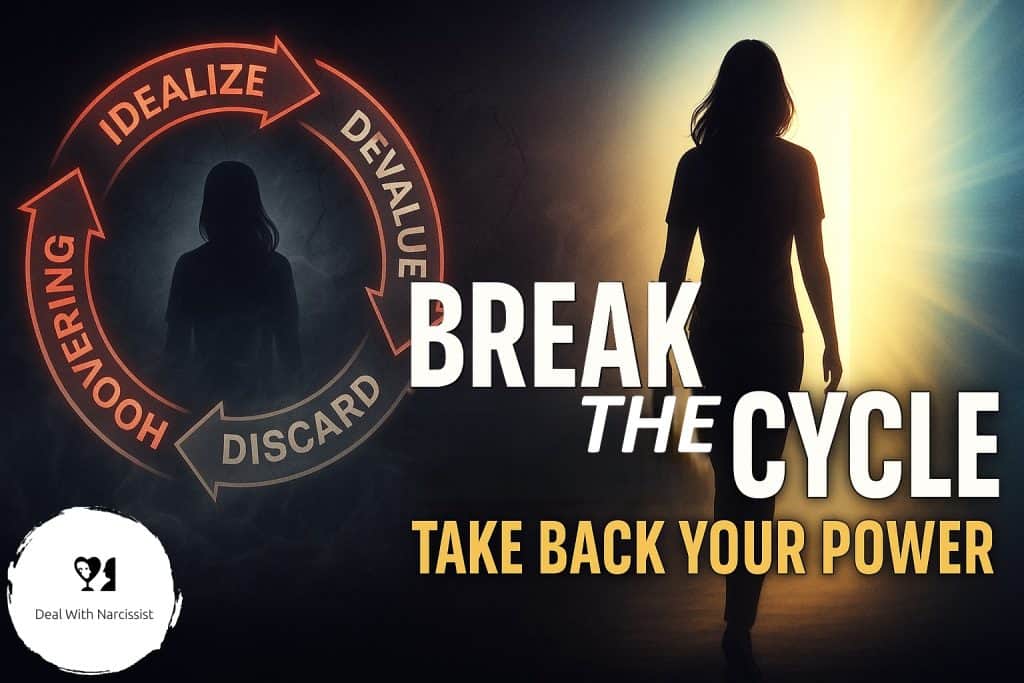
The cycle is built around three main stages – idealize, devalue, discard – with a possible fourth stage, hoovering, where the narcissist tries to pull you back in after a breakup or a period of distance. If this works it becomes a repetitive cycle; a relationship can go endlessly through the cycle until you recognize it and you manage to stop the cycle.
Understanding this cycle is important for two reasons. First, it helps you put words to what happened (or is happening) to you, which can be very validating. Second, it gives you the clarity you need to protect your energy and, eventually, to break free and go into a no-contact situation.
It can, however, be a struggle and very challenging to definitively break the cycle and even more to not be sucked back into it. It requires emotional detachment and a lot of strength and courage to break the cycle. Know, it’s possibly and worth it!
In this article, I’ll first explain the cycle in short, then go into each stage in more detail, and finally share some thoughts on how to break the cycle and start focusing on your own healing again. I hope this article will be helpful to you. You can also watch my YouTube video about the narcissistic abuse cycle, where I walk through the same overview step by step.
Narcissistic Abuse Cycle in Short
Before diving into the stages, it helps to see the cycle as a whole. The model I use is based on the traditional cycle of abuse described by Lenore Walker (1979), adjusted for narcissistic abuse.
The main difference between many non-narcissistic abusers and narcissistic abusers is that narcissists almost never genuinely apologize or take responsibility. They are highly self-centred, feel superior, and are capable of playing the victim while actually being the abuser. Their behaviour is driven by the constant need for attention, control, and narcissistic supply.
I’ve summarized the cycle and added the narcissistic behaviour corresponding with the stages in the following overview:

The narcissistic abuse cycle thus shows three or arguably four stages. In short, these stages are:
- Idealize – The ”perfect” phase: idealization is where the narcissist performs love-bombing, conditional love, intense attention, and interest.
- Devalue – The turn: devaluing is a stage of withdrawal of earlier idealization and showing increasingly more manipulative and abusive behaviour such as guilt-blaming, mirroring, silent treatment, criticism, and gaslighting.
- Discard – The cut-off: abandonment, ghosting, smear campaign, full discard.
- Hoovering – Pulling you back: attempts to suck you back into the cycle after a breakup or distance.
The speed and intensity of this cycle can differ a lot. Some relationships move through these stages quickly, others stretch them out over years. There can be constant back-and-forth between idealization and devaluation. It could be experienced almost simultaneously and it might feel like playing ping pong with great highs and deep lows. The devalue stage can become increasingly abusive; starting with slowly withdrawing idealization into full smear campaigning and silent treatments.
A narcissist will customize their behaviour to who you are or what behaviour they are capable of. How it specifically plays out depends on their intelligence, intent/awareness of their own manipulation, their communication skills and unending needs combined with the person you are and your strengths, vulnerabilities, and beliefs. It’s thus very personal and situational, but the underlying patterns are the same.
In many cases, the cycle continues until you recognize it and find a way to stop it. Sometimes the narcissist ends things when you no longer meet their needs, but even then they may try to hoover you back later. That is why understanding the cycle is such an important first step toward breaking it.
The Victim Choice of a Narcissist
Narcissists don’t connect to people in a healthy or balanced way. Their relationships are built around getting supply: attention, validation, control, admiration, or anything that boosts their ego. Because of this, some narcissists actively look for certain types of people, while others do it more unconsciously. The pattern is similar either way.
A narcissist is drawn to people who offer something they value. This can be status, attractiveness, success, money, kindness, or emotional stability. They are sensitive to how others are seen socially. The more admired or respected you are, the more you can boost their image by being close to them. It’s important to understand that this attraction is not about love or genuine connection. It’s about what you represent to them. Your strengths can be used to elevate their ego, and your vulnerabilities can be used later to control you.
Many narcissists are especially drawn to:
- People who are caring, empathetic, or supportive
- People who work hard to maintain harmony
- People who doubt themselves or are very self-reflective
- People with strong values or emotional depth
- People who are admired or socially successful
To a narcissist, this combination is attractive because it gives them two things: someone they can “win over” for ego boosting, and someone whose empathy can be exploited once the relationship shifts into the devaluation stage. They often mistake the attention they receive in the beginning for real love, because the idealization stage feels good to them as well. But their love is conditional. When their needs become greater than what you can give, the same traits they admired can become targets for devaluing and manipulation.
Understanding this dynamic isn’t about blaming yourself. It’s the opposite. Narcissists often target people who are strong, warm, and emotionally intelligent. The problem is not that you were weak, but that you were open, trusting, and capable of deep connection. Those qualities are strengths, not flaws.
Stages of the Cycle of Narcissistic Abuse Explained
Below, I will go deeper into the stages of the cycle of narcissistic abuse and the corresponding narcissistic behaviour.
1. Idealization Stage
The first stage of the narcissistic abuse cycle is idealization. This is where the narcissist presents themselves as the perfect partner. They overwhelm you with attention, affection, and admiration. Everything feels intense, exciting, and unusually fast. To you, it might feel like a rare and powerful connection. To the narcissist, it is the start of gaining control.
During idealization, the narcissist studies you closely. They want to know your strengths, your insecurities, your hopes, your limits, and what you respond to emotionally. They use this information to mirror you: agreeing with everything you say, matching your values, and becoming exactly who you want them to be.
For some narcissists, this phase even feels like love. They may genuinely believe they found “the one,” but their version of love is built on needs, not mutuality. As long as you provide supply; validation, admiration, attention, status, affection, they stay in this stage. The problem is that their love is conditional which means it will end when their needs are greater than your supply.
As their needs are unending, no one can fulfill them long-term. In order to keep the narcissist satisfied, you would have to cross more and more of your own boundaries, diminish parts of yourself, and accept an unequal relationship. You might allow being less like yourself a bit but there is always a turning point or wake-up call in your mind or soul. Eventually, something shifts: you can no longer meet their demands. This is where idealization slowly fades.
Typical Narcissistic Behaviour in the Idealization Stage
- Love-bombing: Loving and romantic behaviour. A narcissist learns your love language and exactly what you want to hear. They will adjust and customize their loving and romantic behaviour specifically to you. It could involve being praised, getting gifts, going on vacations/trips, having intense sex, and talk about the future.
- Conditional love: The narcissist will give conditional love and make you feel adored, as long as you fulfill their needs. The moment you no longer feed their ego, the warmth disappears. You learn more about this in my article exploring what is love to a narcissist.
- Attention and interest: They seem deeply focused on you: your life, your thoughts, your emotions. A narcissist can be very charming, intelligent, and chivalrous. They are highly developed manipulators and know how to be the ‘perfect’ partner. They can make you feel great about yourself for a while and give you all their attention.
How Idealization Affects You
This phase can feel addictive. Know you can’t blame yourself for not seeing or recognizing what’s going on in this phase. Being loved so intensely can feel like being seen and cherished in a way you’ve always longed for. You may feel special, chosen, and deeply bonded. Many people describe this phase as a kind of emotional “high.”
But slowly, the narcissist becomes the center of your world. Their attention determines your emotional state. You may start adjusting yourself to be the perfect partner they seem to want. No one can be ‘perfect’ so you will start to see the hidden truth of the narcissist when you move into the next stage of devaluation.
If you notice small red flags during this stage you may dismess them; such as sarcasm or provocative comments disguised as jokes, boundary tests, flashes of coldness, or moments where their mask slips. Your intuition may sense something is off, but the positive intensity often makes these signals easy to ignore.
The end of idealization is rarely clear. It fades quietly and is often replaced by confusion, doubt, and the beginning of the next stage: devaluation.
2. Devaluing Stage
The devaluation stage begins when the idealization phase can no longer be maintained. This shift is often subtle at first. You may feel something has changed, but you can’t explain it. Your intuition becomes more active, yet your mind tries to make sense of what’s happening. This is where you might start to questions yourself and get some doubts. This uncertainty is exactly what makes devaluation so destabilizing.
The pace of devaluation can vary widely. For some, it starts slowly, almost invisibly. For others, it begins suddenly. And many narcissists bounce back and forth between idealizing and devaluing depending on how you react. The unpredictability keeps you off balance.
How the Shift Begins
In the beginning, the narcissist quietly withdraws the warmth that defined the idealization stage. They stop giving the attentive behaviours that made you feel special, without explanation. They may start idealizing others instead: praising them, flirting, showing interest elsewhere. This contrast is painful because you’ve already experienced how attentive they can be. You may start to wonder what you did wrong. You may even blame yourself for losing their attention.
During this phase, you might also notice:
- criticism appearing out of nowhere
- sudden impatience or coldness
- emotional distance without explanation
- contradictory behaviour
- strange disappearances or excuses
- a lack of empathy when you express your feelings
As this withdrawal increases, your anxiety and confusion often rise. You find yourself trying harder to “fix” things. This is the trap: the narcissist’s growing detachment makes you chase the connection they created in the beginning.
When the Mask Falls
As idealization fades, the narcissist’s true self becomes visible. Their behaviour can shift drastically:
- Criticism and insults appear.
- Rage can erupt over small things.
- Frustration, blame, and projections become common.
- Manipulative patterns start to dominate.
You become the negative exception in their life and appear to not be worthy of their love anymore. They can still be charming to others, but with you they show contempt, irritation, or emotional coldness. This contrast is intentional and used to control you. The narcissist may double down by saying you are too sensitive, too needy, dramatic, jealous, or unstable. Over time, you may start to believe it.
When their idealization act stops it’s like their mask falls off completely. You will see the person underneath and it’s not pretty. It becomes clear the narcissist doesn’t care about you or your feelings.
Gaslighting and Cognitive Dissonance
Gaslighting is often strongest in this phase. It slowly disconnects you from your intuition, memories, and sense of reality. The aim is to create self-doubt so you become easier to control. At the same time, you experience cognitive dissonance, which is a feeling of discomfort caused by the discrepancy between your positive view of this person and their manipulative behaviour. Your mind is now trying to reconcile two conflicting realities: the loving person from the idealization stage versus the cold, manipulative person in front of you now.
This mental conflict creates anxiety, confusion, and emotional exhaustion. Their actions aren’t consistent with how you see them and your mind will search for ways to reduce this discomfort. Cognitive dissonance is one of the most destabilizing effects of narcissistic abuse, and I wrote an in-depth article about it here: Explaining Cognitive Dissonance and Narcissistic Abuse. This is a subject essential to understand.
Public vs. Private Persona
A narcissist plays a manipulative game and is all about appearance. They often run a dual reality:
- Public: charming, generous, respected
- Private: critical, cold, manipulative, punishing
People around them may admire them and be very positive about them, which makes you doubt yourself even more. These people don’t see or recognize what’s really going on. Anyone who takes the narcissist’s side or unknowingly spreads their narrative is called a “flying monkey”. You can read more about this in: The Narcissist’s Web of Control.
Silent Treatment, Stonewalling, and withdrawal
As the devaluation intensifies, communication starts to break down. The narcissist may use the silent treatment, stonewalling, emotional withdrawal and showing a lack of affection. These are all forms of silent treatment. These techniques are passive-aggressive methods in order to gain control by avoidance, silence and disempowerment. They punish you by withholding connection, forcing you into emotional desperation. These behaviours often sit between the devaluation stage and the upcoming discard stage, as these are methods of withdrawing communication and creating distance.
Clearly, the silent treatment is a very disrespectful and unhealthy way of ‘communication’. You can learn more here: The Silent Treatment Explained and How To Deal With it.
What Devaluation Does to You
During this stage, victims often experience:
- anxiety
- confusion
- self-blame
- emotional exhaustion
- low self-worth
- a feeling of “not being yourself anymore”
This is not because you are weak. It’s because you’re being emotionally destabilized on purpose. The relationship becomes about walking on eggshells, trying to avoid conflict, and trying to regain the connection that once felt so strong.
It’s common to feel ashamed or confused about staying. But the combination of idealization and devaluation creates a strong psychological bond. It conditions you to seek approval from the person who is hurting you.
Exploitation of Strengths and Vulnerabilities
An intelligent narcissist uses both your strengths and weaknesses:
- your empathy
- your kindness
- your fear of abandonment
- your forgiveness
- your desire to work on yourself
- your loyalty
Nothing they learned during idealization is forgotten. All of their attention and questions asked becomes knowledge useful to manipulate and control you. It becomes part of how they try to control you. If you want to understand these dynamics more deeply, you can read: The Empath-Narcissist Relationship. I go into unhealthy relationship dynamics such as the narcissist taking and the empath giving, the empath feeling responsibility for the behaviour of the narcissist, and more. It’s a very toxic relationship abusing the other person’s vulnerabilities, helpfulness, and empathy.
3. Discard Stage
The discard stage often arrives suddenly and without any real warning. Everything may appear normal, and then out of nowhere you receive a cold text, a short message, or a blunt dismissal that feels shocking. Sometimes there is a smear campaign where they blame you for everything, twist the story, or try to damage your reputation. Other times they simply vanish and ghost you completely. No explanation, no conversation, no empathy. It’s a brutal way of ending a connection, and it can feel deeply destabilizing.
In this moment, you suddenly feel like you mean nothing to them. As painful as it is, this shift doesn’t happen because of who you are. It happens because to a narcissist, the relationship was transactional from the start. You existed to fulfill their needs, and when those needs are not met, or when they become bored or move on, they detach without hesitation. They don’t reflect on the impact or consider your feelings. They don’t experience the breakup with the same emotional depth you do.
For you, this experience can feel humiliating, confusing, and deeply painful. You invested real care and emotion. You believed in the version of them they showed in the beginning. Losing that connection, and losing it in such a cold and cruel way, can feel traumatic. The lack of closure makes it even harder. Most people never receive answers, apologies, closure or a respectful conversation. They’re left alone with a sudden emotional shock.
The discard can have serious effects. Many people experience symptoms of depression, anxiety, trauma, and overwhelming self-doubt. If you didn’t know what you were dealing with, it’s easy to blame yourself or believe that you somehow caused the abuse. That self-blame is one of the most damaging parts of this stage.
This is why knowledge matters. Therefore, I want to spread knowledge and hopefully help others this way. Understanding the discard doesn’t make the pain disappear, but it allows you to see the dynamic more clearly and recognize that the cruelty you experienced was not your fault. Surviving this stage is the beginning of a longer healing process, and it’s completely okay to seek support during this time. Speaking with a therapist can help you make sense of what happened and slowly rebuild your confidence, your energy, and your sense of self.
If you prefer online therapy, I personally recommend Online-Therapy.com. Their approach is grounded in cognitive-behavioural therapy (CBT), mindfulness, and emotional support; methods that align beautifully with my principles. You deserve support, clarity, and someone who understands what you’ve been through. You don’t have to handle this alone.
🌼 Find a licensed therapist online →
(By using my affiliate link you will receive a discount of 20% off for your first month with code THERAPY20)
4. Hoovering
After the discard, many people hope the pain will finally stop. Sadly, this is often the moment a narcissist returns. This stage is called hoovering — named after a vacuum cleaner — because the narcissist attempts to “suck” you back into the relationship and restart the cycle.
Hoovering doesn’t always happen right away. It can happen days, weeks, months, or even years later. It usually appears when the narcissist feels bored, lonely, insecure, or low on supply. When they sense you’ve started to detach, heal, or move on, their instinct is to pull you back in. Hoovering can take many forms. Some narcissists use warm messages, nostalgia, apologies that aren’t real, or sudden acts of “kindness.” Others use guilt, fear, or obligation. The goal is the same: to reopen the connection, regain access to your emotions, and restart the cycle of idealization and devaluation.
What makes hoovering painful is that it targets your strengths and hopes. The narcissist knows what you care about, what you fear, and what makes you vulnerable. They can use your empathy, your loyalty, or your desire for closure to pull you back in. This isn’t affection or change: it’s manipulation designed to regain control.
If you’re not aware of the cycle, hoovering can be incredibly confusing. You may think they finally realized your worth, regret losing you, or want to fix things. But once you re-engage, the cycle starts again. Idealization returns for a short moment, then devaluation, and later another painful discard.
Recognizing hoovering is essential for breaking the cycle. When you can name it, you can step back, breathe, and respond from clarity instead of emotion. I wrote a separate article that explains the different tactics used during hoovering and how to deal with them: Hoovering by a Narcissist.
Frequently Asked Questions About The Narcissistic Abuse Cycle
1. What is the narcissistic abuse cycle?
The narcissistic abuse cycle is a repeating pattern of idealization, devaluation, discard, and sometimes hoovering. It explains how a narcissist gains control, destabilizes your self-worth, and keeps you emotionally attached.
2. Why is the idealization stage so intense and convincing?
Idealization feels powerful because the narcissist mirrors your needs, your values, and your emotions. They study you and present themselves as the perfect partner. It isn’t genuine love; it’s a strategy to build trust and emotional dependence. Many people mistake this stage for a once-in-a-lifetime connection, which is why the later stages are so painful.
3. How do I know if I’m being devalued?
Devaluation often starts quietly. You may notice sudden coldness, criticism, inconsistency, silent treatment, or gaslighting. You might feel anxious, confused, or less like yourself. If you’re constantly trying to “fix things” or earn back the earlier warmth, it’s a strong sign this stage has begun.
4. Why is the discard stage so traumatic?
The discard is usually sudden, cruel, and without explanation. There’s no closure, no empathy, and no honest conversation. You invested real feelings while the narcissist treated the relationship as transactional. This emotional mismatch creates shock, deep pain, and self-doubt. Many people blame themselves until they understand the cycle.
5. How do I break the narcissistic abuse cycle and start healing?
Breaking the cycle takes clarity, emotional distance, and support. Many people start with the grey rock method and then move toward no contact when possible. Learning about the cycle helps reduce confusion and rebuilds your sense of reality. Healing comes from small, steady steps that shift your focus back to yourself: your energy, your boundaries, your confidence, and your peace.
Breaking the Cycle
Breaking the narcissistic abuse cycle is not simple, and it’s important to acknowledge that. For many people, leaving the relationship is not a single moment but a long internal process. It takes emotional detachment, clarity, support, and the slow rebuilding of your own strength. The truth is that even when you know the relationship is unhealthy, it can be very hard to let go. Trauma bonds, hope, fear, and confusion all play a role.
You don’t have to judge yourself for struggling. You’re human. The goal is not to make a perfect exit. The goal is to take steady steps toward protecting your energy and regaining your sense of self. It’s all about starting to take small steps in the right direction.
One of the first tools people use is the grey rock method; becoming emotionally unresponsive and as “boring” as possible in order to reduce the narcissist’s control and minimize their supply. It’s not a long-term solution, but it can help when going no contact isn’t possible yet. You can read more about it here: The Grey Rock Method.
Another important step is understanding what to expect when you leave. Narcissists often respond to breakups with anger, manipulation, hoovering, or new attempts to regain control. Knowing this ahead of time helps you stay steady and grounded. If you want to learn more about what happens when you break up with a narcissist, you can read that article here: What to Expect When Breaking up With a Narcissist.
Over time, the focus shifts away from the narcissist and back to you. This is where healing happens. Conscious breathing, mindfulness, and small daily practices can help you reconnect to your body, calm your mind, and slowly rebuild your confidence. If you want to explore this further, you can read my guide on mindful breathing and shifting attention back to yourself.
Breaking the cycle is not about being strong every day. It’s about choosing yourself again and again, even in small ways. And every small step matters.
Gentle recommendations for next steps
People often tell me that the hardest part is understanding what happened and then figuring out how to move forward. To support you in this, I created a free guide From Fog to Clarity. This gentle free starter guide summarizes key insights from my work and offers a steady place to start if you’re feeling lost or overwhelmed.
📥 Learn more and get your free e-book
If you want to go deeper and learn how to recognize manipulation clearly, break free emotionally, and rebuild your self-worth, I also wrote a full e-book Recognition Code for Narcissism. This e-book is a gentle yet powerful guide to recognizing narcissistic behaviour, understanding its emotional impact, and finally shifting the focus back to where it belongs: you. It’s written with kindness, clarity and compassion.
📚 Learn more about the full e-book →
This article could have been written about my last relationship. It describes it to a “T”!! My husband had passed away and I was vulnerable. I remembered a guy from my past and when he accepted my friend request, I came home. He messaged me when I got to my hometown and we met at the city park. It all started from that meeting. I mentioned the life insurance I’d be getting in the next couple of days. He was perfect!! I’ve never had so much in common with someone. The sex?? Omg!!! There was a couple red flags I ignored. He hadn’t seen his daughter in over a year and they lived in the same town. I also had a trip to Germany planned and while I was there he spent 36 hours texting his sister in law. Over 200 texts to her while 9 to me! The devaluing stage was so subtle! I wasn’t sure he’d really meant the little jabs or was I misinterpreting them? That part went on for 2 years. I got a text message at work informing me he had. I feelings for me and he’d tried but sorry. I tell people how weird it was that the night before he had emotion in his eyes but that day it was gone! He knew of my buttons that would get me suicidal. He not only pushed them he tap danced on them! He and his little flying monkey who gets off on the abuse. He would ghost me for days then be sweet and fakely apologetic. He spent hours making his rounds to every female friend he had to hurt me more. I found out he’d been going over to the 25 year old office girls house every day while I was working. He was trying to hook up with her but he was twice her age. He’d also started the smear campaign a year before. I had no clue. He told people we were broken up and I was so obsessed with him I refused to leave! He told people that and I lost a lot of friends then he gave me an eviction notice allegedly from his mom our landlord. It was written by him and his flying monkey! He did do something uncharacteristically of him. He showed his cruel treatment of me to his friends and supporters. They have now distances themselves from him and helped me. He decided at the last minute to not allow me to get my stuff from the house. He had gone through everything I’d packed and took what he wanted. He also had agreed to allow me to store it in a spare room for 2 months and conveniently forgot ever saying I could. I have the text messages that prove it. He has moved on to a new relationship. He met her on a dating site and they are madly in love. I am working on me and am not interested in dating right now. I have been journaling like crazy and have found the strength to see him for the toxic person he is. He seemed to get angry that I wasn’t pining over him anymore. When I saw him, I literally felt nothing! He is nothing to me. I don’t find him attractive at all anymore!! He’s ugly and makes me cringe when I think about how much I loved him and craved his affection. I said I feel nothing for him? That’s a lie. I feel regret. It’s my biggest mistake I’ve ever made!!
Thank you for your articles. I can’t believe how accurate they are. He left me broke, essentially homeless, and yet stronger than I ever would have imagined! He failed miserably in his quest to destroy me! Had he not created the space away from him by ghosting me, I’d still be stalking him and trying to fix it.
Thank you for sharing your story Kelly and I’m thankful if my articles can provide some help in your process. I’m sorry you had to experience this. It’s very brutal and disturbing how this kind of manipulation works. I understand you feel regret but know you can’t blame yourself for being manipulated this way. He abused your vulnerability and worked in very subtle ways.
I’m glad you had the strength and courage to recognize the truth and the toxic situation and you managed to break free. The pain and your experience allow you to become stronger now and it’s inspiring you turned this around into working on yourself. Great you have been journaling and that you’re working on healing. It’s a good thing your friends recognized the situation as well as you can use their support in recovering.
Keep working on you! You are worth your own loving attention. I wish you strength and more kindness in the future. Take care!