Emotions After Narcissistic Abuse: 8 Feelings Narcissists Create (And What They Use Against You)
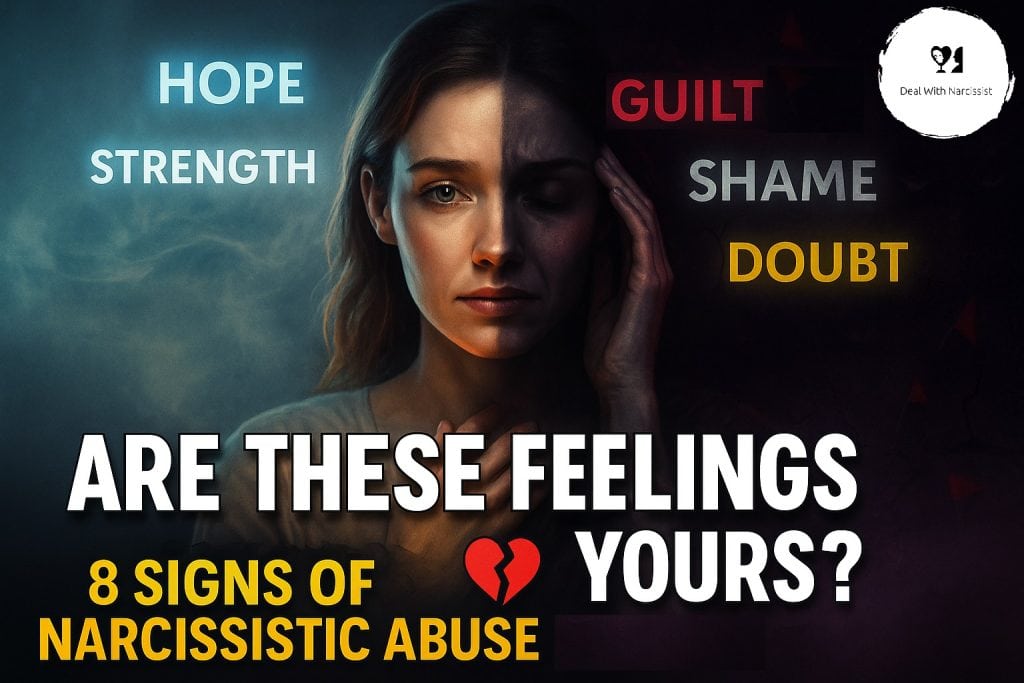
If you have experienced narcissistic abuse, you probably know how overwhelming your emotions can become. You might feel guilty, ashamed, anxious, angry, confused, or simply exhausted. It can feel like you’re losing yourself and you no longer trust your own feelings.
In this article, I explore emotions after narcissistic abuse. I will walk through eight painful feelings narcissists often create or intensify and which human qualities they abuse to do it. My aim is to help you recognize what is happening inside you, so you can gently shift attention back to yourself and start protecting your energy again.
These feelings are not proof that something is wrong with you. They are natural responses to manipulative behaviour. I’m sorry if you recognize yourself in this and I hope this guide can give you clarity, language, and a bit of support while you read.
Why Narcissistic Abuse Hits Your Emotions So Hard
Dealing with your own thoughts, fears, and feelings is already a challenge in normal circumstances. When a narcissist enters the picture, they often push your mind and energy in the wrong direction without you even realizing it at first. To understand why your emotions feel so intense and confusing, it helps to look at the pattern behind their behaviour.
The Narcissistic Abuse Cycle In Short
The narcissistic abuse cycle usually moves through three main stages: idealization, devaluing, and discarding.
In the beginning, everything often feels magical. You may be showered with attention, affection, and admiration. This idealization phase can feel like a deep bond or even a kind of “soul connection.” Sadly, it’s temporary.
Over time, the narcissist starts to devalue you. Criticism, emotional distance, controlling behaviour, and subtle put downs increase. You might start doubting yourself and try to “get back” to how things were in the beginning.
If you pull away or confront them, they may discard you in a cold or cruel way. Later they might also try to hoover you back in with promises, apologies, or dramatic gestures. This whole cycle repeats and each round usually gets more painful.
Cognitive Dissonance: When Your Feelings And Their “Truth” Collide
A big reason why emotions after narcissistic abuse feel so chaotic is something called cognitive dissonance. It’s the mental discomfort you feel when your beliefs and values do not match what is actually happening.
With a narcissist this often looks like:
- They act “normal” while doing things that are not normal or kind (manipulative behaviour).
- They react very harshly when you behave in a normal way, for example by setting a boundary (healthy behaviour).
- They swear they love you while their actions feel cold, cruel, or dismissive.
Your nervous system registers that something is off. At the same time, their strong “truth” and explanations push you in the opposite direction. This creates anxiety and confusion. To reduce that discomfort, your mind may start bending reality, blaming you, or ignoring your own intuition.
The Human Qualities Narcissists Abuse
Narcissists rarely target people because they are weak. Quite often they target people because they are strong in ways that are useful to the narcissist. For example:
- your empathy and ability to care deeply
- your sense of responsibility and loyalty
- your hope and belief that people can change
- your willingness to work on yourself
These are beautiful qualities. The problem is that narcissists twist them and use them to create guilt, shame, fear, dependency, and other painful feelings. The rest of this article goes into eight common emotions and which qualities they pull on.
8 Emotions Narcissists Create Or Intensify (And The Traits They Use Against You)
Each section below explains how the emotion often feels for you, how the narcissist stirs or deepens it, and which human quality they abuse.
You do not have to identify with all eight. Even if only some of them resonate, it can already bring more clarity about your inner world.
1. Guilt
Guilt is one of the main tools narcissists use. It can feel like you’re always doing something wrong. You may feel responsible for their moods, their anger, their sadness, their stress. You might apologize for things that are not your fault or change your behaviour again and again to keep the peace.
Narcissists are very skilled at blame shifting. They rarely take responsibility. If something goes wrong, there is always someone else to blame, and very often that person is you. Because you care and you’re able to self reflect, you’re more likely to ask yourself what you did wrong. They know this and lean into it.
They also often pull on your hope that you can help them or even “heal” them. If you’re empathic, you may have a deep drive to support others and to see the best in them. This is a beautiful trait, but with a narcissist it becomes a risk. They use your empathy against you. Underneath the guilt, the message you slowly receive is: “You’re not worthy and you deserve this treatment.”
The abused qualities here are your empathy, sense of responsibility, and wish to help.
2. Perfectionism
Perfectionism in this context is not about wanting to do a good job. It’s about feeling you must be perfect to be safe, accepted, or loved. With a narcissist you might feel you have to say the right thing, react in the right way, look the right way, anticipate their needs, and never disappoint them. You may constantly scan yourself: “Did I say something wrong? Should I have done more? How can I prevent the next conflict?”
Narcissists often have unrealistic expectations of others. They feel entitled to special treatment and believe things should always revolve around them. This pushes you into trying harder and harder to be the perfect partner, child, friend, or colleague.
The problem is that their needs are bottomless. It’s like a bottle with no bottom. You can pour water into it all day but it never fills. You can try to be perfect for them, but the target will always move.
Here they abuse your conscientiousness, loyalty, and wish to make relationships work. Recognizing that no amount of perfection will change the dynamic is a painful but important step.
3. Shame
Shame goes deeper than guilt. Guilt says, “I did something wrong.” Shame says, “There is something wrong with me.” In a relationship with a narcissist you may feel ashamed of your reactions, ashamed that you stayed, ashamed of things they throw in your face, or ashamed to talk about what is happening at all. This shame can make you feel very alone.
Narcissists often create or deepen shame by:
- humiliating you in private or in front of others
- making cruel “jokes” at your expense
- attacking your sensitivity, body, intelligence, work, or family
- projecting their own hidden shame onto you
They build an identity of being superior and in control. Underneath that identity there can be a lot of unprocessed shame and insecurity. Instead of facing it, they may project it onto the people closest to them so they do not have to feel it.
The qualities abused here are your care for other people’s opinions and feelings, your desire to be good, and your loyalty.
Sometimes shame also shows up because you already know, on some level, that the situation is unhealthy yet you feel unable to leave. There is compassion needed here, not judgment. It’s hard to leave an abusive bond, especially when old wounds and attachment issues are involved.
4. Self Doubt And Low Self Worth
A narcissist’s truth often feels very strong. They may sound completely convinced about their version of events, even if it’s not true. Over time, this can slowly erode your confidence in your own perception. You might notice thoughts like:
- “Maybe I overreacted.”
- “Maybe I’m the problem.”
- “Maybe it really is all in my head.”
Narcissists use many manipulation tactics to create this self doubt, for example:
- Gaslighting: denying what happened, twisting facts, rewriting conversations.
- Silent treatment: withdrawing affection and communication to punish you.
- Word salad: long confusing arguments where you end up defending yourself without knowing what you’re defending against.
Gaslighting is especially brutal. It’s ongoing manipulation and brainwashing that causes increasing self doubt and can lead to losing your sense of perception, identity, and self worth. Because it happens slowly, you often do not realize it while you’re in it.
Here they abuse your capacity for self reflection and your willingness to own your mistakes.
5. Anger
Anger in this context can show up in different ways. You might feel:
- rage at how you have been treated
- anger that you stayed so long
- anger at yourself for not “seeing it earlier”
Narcissists often thrive on emotional responses. They learn how to push your buttons and may use anger strategically, both their own and yours.
They might:
- provoke you until you react, then point at your reaction as “evidence” that you’re unstable
- use outbursts of rage to intimidate and control you
- hold on to their own anger, resentment, and frustration, filling the atmosphere with tension
Because their need for admiration and validation can never be fully satisfied, they often carry a lot of frustration inside. That disturbed energy will constantly influence you and drain your energy.
The quality abused here is your sense of justice and your emotional openness. Part of healing is learning to see anger as a signal that a boundary has been crossed, not as proof that you’re a bad person.
6. Dependency
Dependency in abusive dynamics can feel like a mental and emotional prison. Thoughts like “I can’t leave,” “No one else will want me,” or “I’m nothing without them” can appear again and again. Narcissists often try to create and deepen this dependency by:
- isolating you from friends and family
- controlling finances, information, or access to support
- alternating between affection and cruelty so you cling to the good moments
- using phrases like “you’re nothing without me” or “who would love you if I wasn’t here”
At the same time, the narcissist is deeply dependent on others’ opinions. They need narcissistic supply and constant external validation. They can’t validate themselves in a stable way, which makes them a slave to praise and attention.
Here they abuse your loyalty, attachment, and fear of abandonment.
7. Walking On Eggshells, Fear, And Anxiety
Many survivors describe the feeling of constantly walking on eggshells. You might feel you have to think through every word, every text, every look, just to avoid an explosion or cold withdrawal. This tension comes from:
- unpredictable reactions
- frequent blaming and criticism
- silent treatments that come out of nowhere
- threats to leave or harm the relationship
Your nervous system becomes hyper alert. Your body is often in a state of anxiety or fear. This is not because you’re “too sensitive.” It’s because your system is trying to keep you safe in an unsafe emotional environment.
Narcissists abuse your sensitivity to others and your wish to keep the peace.
8. Hopelessness
When all these emotions pile up, hopelessness often follows. You may feel like the narcissist has real control over you, almost as if there is a solid wall in your mind you can’t walk through. It can feel impossible to imagine a different life. This hopelessness is strengthened by:
- repeated cycles of idealization and devaluation
- broken promises to change
- old wounds from childhood that are triggered by the relationship
- fatigue from constant emotional work
It’s understandable to feel hopeless when you’re exhausted and emotionally entangled. At the same time, it’s important to remember: the wall in your mind was built to protect you. You also have the ability to carefully take it down.
Here they abuse your loyalty, attachment history, and deep wish for connection. Your situation is not hopeless, even if it feels that way right now. The path out may be slow, but it’s there.
Your Intuition Is Not The Enemy
Under all the chaos, your intuition quietly registers what is really happening. You may feel a small voice inside saying, “Something is off.” Often this voice appears long before your mind can explain why.
Narcissistic abuse tries to pull you away from this inner sense. The constant blaming, gaslighting, and minimising of your experiences teach you to ignore your own signals and to believe their version instead.
Part of healing is learning to hear your intuition again and to treat it as a friend rather than a problem. Practices like conscious breathing, mindfulness, and Buddhist meditation can help reduce noise so that intuition becomes clearer again.
From Emotional Chaos Back To Yourself
Healing from emotions after narcissistic abuse is not just about understanding the narcissist. It’s also about understanding the pattern and then choosing small steps back to yourself.
Step 1 – Learn The Pattern, Not Just The Person
It can be tempting to focus completely on the narcissist, trying to understand their mind or predict their behaviour. While some understanding is useful, the real power lies in recognizing the pattern of abuse itself.
Learning about:
helps you see that your emotions are understandable reactions to a known pattern. These patterns are all focused on behaviour. This is not about labelling every difficult person as a narcissist. It’s about recognizing when someone consistently crosses your boundaries and twists your reality.
Step 2 – Start Emotional Detachment And Energy Protection
You can’t change the manipulative behaviour of another person or take responsibility for it. What you can do is slowly reduce the emotional hooks this person has in you. For some people, this eventually means going no contact. For others, there may be practical reasons why that is not possible right away, for example with a co-parent or family member. In those cases, emotional detachment becomes extra important.
A few tools that can help:
- The grey rock method – staying neutral and uninteresting to reduce emotional engagement when contact is unavoidable.
- Conscious breathing – simple breathing exercises to ground yourself and calm your nervous system.
- Buddhist meditation – gently training your mind to observe thoughts and emotions without being pulled into them.
- Working on self worth – slowly rebuilding a more stable sense of who you are, independent of the narcissist’s opinion.
These are not quick fixes. They are small ways of shifting your focus from the narcissist back to yourself.
Gentle Closing Thoughts
If you recognize yourself in these eight emotions, please know this:
- You’re not “too sensitive.”
- You’re not weak for feeling this way.
- Your emotions make sense in the context of what you have been through.
Emotions after narcissistic abuse can be intense, confusing, and painful. At the same time, they can also be signals that something in you is asking for protection, honesty, and kindness.
Healing does not mean you never feel guilt, shame, anger, or fear again. It means you slowly learn to see where these feelings come from, which ones belong to you, and which ones were planted there by someone else. It means you begin to treat yourself with the same compassion you often give so freely to others.
You do not have to fix everything at once. You only need to take small steps, one moment at a time.
I hope this article was helpful to you. I wish you strength, kindness, and more clarity in the future💜.