
Buddhist Meditation for Narcissistic Abuse Recovery: How to Protect Your Energy and Rebuild Clarity
After dealing with a narcissist, your mind often becomes tense, noisy, and tired. You might feel anxious, confused, or full of self doubt. Their behaviour can pull you away from your own intuition and create a lot of internal chaos. It can take time before you feel like yourself again.
In this article, I explore how after narcissistic abuse Buddhist meditation can help you calm your system, protect your energy, and slowly regain clarity. You don’t need to be a Buddhist for this. These practices are simply gentle ways of working with your mind and shifting your attention back to yourself.
From my own experience with narcissistic behaviour in my family, meditation became one of the tools that helped me breathe again. It helped me see what belonged to me and what didn’t. It helped me soften the noise in my mind and reconnect with my intuition. That is why I share these ideas with you. I hope they can support you too.
Why Meditation Helps After Narcissistic Abuse
A narcissist often pulls you into their world of ego, control, and emotional instability. Over time your mind can become anxious, tense, or disconnected from your own truth. Thoughts become loud and repetitive. Your intuition becomes harder to hear. You may second guess everything, including yourself.
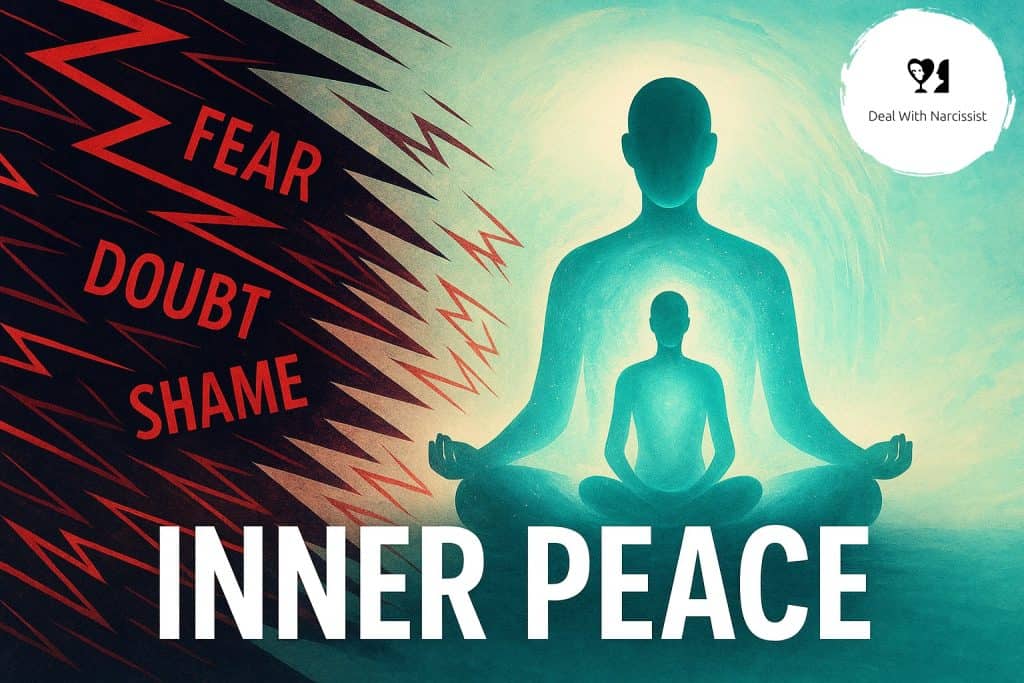
Meditation helps because it reduces this mental noise. When you create even a small amount of inner stillness, your system can breathe again. You start to see your thoughts more clearly. You notice your emotions instead of being overwhelmed by them. You begin to feel the difference between your own energy and the energy of others.
In a way, meditation slowly returns your attention to where it belongs: inside.
Meditation as Letting Go
Meditation is a practice of letting go: not by force, but by softening your grip on everything. You stop running after every thought. You stop trying to solve everything in your head. You stop fighting the moment. Instead, you gently let yourself be here.
Many of us think endlessly about things that have already happened or things that might happen. It’s like chewing the same thoughts again and again. Meditation interrupts that cycle. You stand still inside yourself. You take a breath. You notice where you are.
Thich Nhat Hanh describes this as a dynamic, awake presence. You don’t need to perfect anything. You only need to notice.
Meditation, Ego, and Narcissistic Dynamics
A narcissist’s mind is focused outward. They depend heavily on external validation, image, and control. Their ego needs constant feeding. Because their inner world is unstable, they often project their discomfort onto others. This makes their environment tense and draining.
Meditation points in the opposite direction. It turns the mind inward. It helps you loosen the need for external confirmation and reconnect with your own inner stability. It reminds you that power does not come from controlling others: it comes from clarity inside yourself.
When you meditate, you slowly see your thoughts with more honesty. You learn to feel your intuition again. You become more aware of which emotions belong to you and which came from manipulation, fear, or confusion. This is a gentle, powerful way to protect your energy.
Meditation Is Hard Work (And That’s Normal)
Ajahn Brahm is very honest: meditation takes effort, especially in the beginning. When you first sit down in silence you might feel even more noise in your head. You might think the meditation is going wrong. You might feel restless or impatient.
This is normal.
You’re not failing, you’re becoming aware. Meditation is not about getting rid of thoughts. It’s about seeing them without fighting them. It’s about noticing how much pressure you put on yourself. It’s about letting your system settle at its own pace.
A quote from Ajahn Brahm describes this beautifully:
“The effort is learning to let go… to relinquish… to give up the things that arise.”
Letting go is the real work.
Five Practical Buddhist Meditation Tips
These tips are inspired by Buddhist meditation, especially the teachings of Ajahn Brahm. They are not rigid rules. They are gentle directions that help you reconnect with yourself, calm your inner world, and protect your energy when you’ve been shaped by narcissistic behaviour.
Tip 1 — Enjoy Being Quiet
Silence is not the absence of sound. It’s the absence of internal pressure. When you first sit down and try to be quiet, you might notice how noisy your mind actually is. This is normal. You haven’t “failed” at meditation, you’re finally seeing what was already there.
Being quiet is not about forcing your mind into calmness. It’s about allowing yourself to pause, even if you don’t feel calm yet. Try to sit with the intention: “Nothing needs to happen right now.” This alone can shift your energy.
What usually happens next is a small moment where the inner talk stops and you feel yourself breathe. These small gaps matter. They are the beginning of clarity. Over time they grow naturally. If you have even one moment where you feel your shoulders drop or your breath move more freely, that is meditation working.
To close this tip, I want to share one of my favorite reflections from Thich Nhat Hanh:
‘Silence is essential.
We need silence,
just as much as we need air,
just as much as plants need light.
If our mind is full of words and thoughts,
there is no room for ourselves.‘
Tip 2 — There Is No “Bad” Meditation
Most people assume meditation should feel peaceful. In reality, the first stage of meditation often reveals everything you’ve pushed down: restlessness, fear, old thoughts, old emotions. This can feel uncomfortable, but it’s part of the healing process.
If your mind gets louder during meditation, it doesn’t mean it’s “not working.” It means you are finally aware of what has been running in the background. Ajahn Brahm compares this to training a muscle: the “difficult” sessions are the ones that build the strength.
Instead of thinking: “I’m doing this wrong,” try: “This is what my mind looks like right now, and that’s okay.”
Meditation is not about achieving silence. It’s about developing a kinder, more patient relationship with your mind over time. If you can sit with yourself for even a few minutes, you’re already doing the work. It will be worth it.
Tip 3 — Be Patient in Building Up Meditation
Many survivors of narcissistic abuse have a restless mind. Your thoughts may jump between the past and the future, replaying conflicts, trying to predict danger, and scanning for emotional threats. This is your nervous system trying to protect you, even if it doesn’t feel that way. Meditation won’t immediately silence this. Expecting that only creates frustration.
Ajahn Brahm teaches that meditation has stages, you don’t jump directly into deep breathing meditation. You begin with grounding awareness. This could be:
- feeling your feet on the floor
- placing a hand on your chest
- listening to the sounds in the room
- noticing one breath at a time
These simple steps calm your system enough to make deeper meditation possible later. Think of it as “preparing the soil before planting.”
Be patient with this process. Healing the mind after narcissistic abuse is not a straight line. Small daily steps matter far more than intensity. Two minutes each day builds more peace than twenty minutes once a month.
Tip 4 — You Don’t Need to Feel the Breath in a Specific Place
People often ask: “Should I feel my breath at my nose? My belly? My chest?”
Ajahn Brahm’s answer is simple: it doesn’t matter. If you stare too much at a specific point in your body, you leave the experience of the breath and enter “technique mode.” This actually pulls you out of meditation.
What matters is the experience itself:
- Is the breath warm or cool?
- Soft or deep?
- Fast or slow?
- Heavy or light?
You don’t need to change or analyse anything. You’re only noticing. Let the breath be what it is. Let your awareness rest on it gently. Your breath is the most honest thing you have. It always tells the truth about your emotional state. When you learn to notice it without controlling it, you reconnect with your body in a very real way.
Tip 5 — Don’t Try to Control Your Breathing
A common habit when you start meditating is trying to “help” the breath by making it smoother, deeper, calmer. But this creates tension.
Your only job is to watch the breath breathe on its own. Here’s a simple way to feel the difference:
- Take one breath “on purpose.” Notice the tension.
- Then sit back and let your body inhale on its own. Notice the softness.
The second breath is what meditation feels like.
When you stop controlling your breath, your body naturally shifts into a calmer state. This is where clarity grows. When your breath softens, your thoughts soften. When your thoughts soften, your emotions become easier to observe without fighting them.
This is how meditation protects your energy: not by escaping life, but by reducing the grip of overthinking that narcissistic dynamics often create.
Self Compassion Is Part of Meditation
Meditation is not just about awareness. It’s also about how you treat yourself while becoming aware. Many survivors of narcissistic abuse develop a harsh inner voice. You may speak to yourself with the same tone the narcissist used. You don’t deserve that. Meditation helps you notice this and gently adjust it.
If your inner voice is harsh, impatient, or demanding, that does not mean it’s “you.” It means the mind has been shaped by stress. Try to observe the tone of your inner voice with honesty. Is it judgmental or demanding? Does it blame you? Does it push you too hard? You don’t have to agree with the voice in your head. You can slowly teach it a new tone. You can set boundaries inside your mind too.
Choosing a softer tone inside your own mind is not only part of meditation: it’s also part of rebuilding your self worth. Many survivors speak to themselves with the same harshness they once received. Learning to shift that tone, even just a little, is a quiet form of healing. If you want to explore this more deeply, you can read my guide on rebuilding your self worth after narcissistic abuse.
A small act of self compassion in meditation counts more than a perfect technique.
Gentle Closing Thoughts
Buddhist meditation is not about becoming the perfect spiritual person. It’s about slowly returning to yourself. It’s about creating a small pocket of stillness in a mind that has been overwhelmed. It’s about noticing which thoughts belong to you and which ones came from manipulation or fear.
You don’t have to get this right all the time. You only need to take small steps, one moment at a time. Trust the process, choose kindness, and take the next gentle step forward.
I hope this article was helpful to you. I wish you strength, kindness, and clarity💜.