
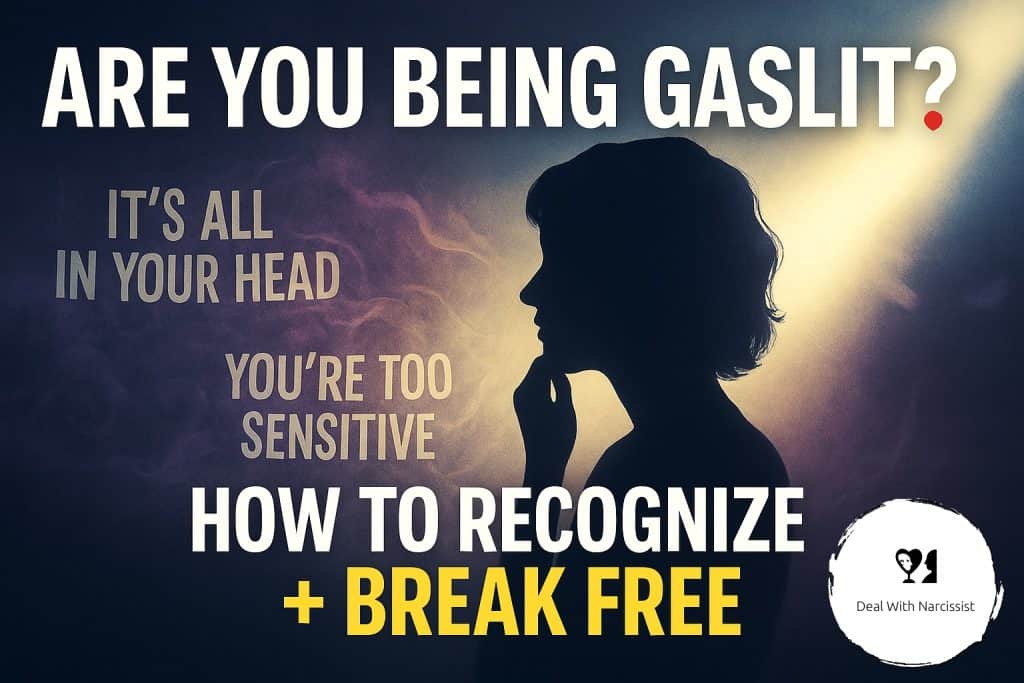
Gaslighting by a Narcissist: What It Is, 8 Signs, and How to Rebuild Your Reality
Do you keep doubting your own thoughts, memory, or feelings? Do you find yourself apologizing all the time or wondering if you are “too sensitive”? Do you feel more confused the longer you stay in the relationship? If so, you might be dealing with gaslighting.
Gaslighting is one of the most damaging forms of manipulation used by narcissists. It does not start loud. It begins slowly, with small comments that plant doubt and make you question what you saw, heard, or felt. Over time it disconnects you from your intuition and your inner truth. That is what makes it so dangerous.
It’s essential to recognize this pattern early. If you do not see it for what it is, the manipulation can quietly drain your energy and make you slowly disconnect from yourself. The earlier you notice what is happening, the sooner you can begin to rebuild trust in your own mind again.
My aim with this guide is simple. I want you to understand what gaslighting is, spot the early signs, recognize the deeper impact, and learn how to protect your mind and rebuild trust in yourself. You deserve clarity and to feel grounded in your own reality again.
If you have been gaslighted for a long time, recovery takes time. Your confidence might feel shaken, your sense of reality might feel blurry, and your self-worth might feel impacted. Healing starts with awareness. After emotionally detaching from the narcissist, the next step is shifting your attention back to yourself, your energy, and your needs. You deserve your own love, care, and kindness💜.
Now let’s start with the basics.
What Is Gaslighting?
Gaslighting is ongoing psychological manipulation that slowly makes you doubt your own perception, memory, and judgment. It is not a misunderstanding or a single argument. It is a repeated pattern that chips away at your clarity over time.
Someone who gaslights creates small cracks in your sense of reality. They deny things you clearly remember. They claim you misheard or misunderstood. They rewrite conversations. They question your memory with confidence. They act as if your natural reactions are overreactions. Over time, this adds up. Bit by bit, you stop trusting yourself. You become unsure of yourself and turn to them for the “truth.” That dependence gives them control. The effect is psychological confusion that often feels like fog, self-blame, anxiety, or even a sense that you are “losing yourself.”
The word gaslighting comes from an old play called Gas Light, where a husband secretly dims the lights at home and denies it every time his wife questions it. She starts doubting her senses, because she cannot imagine he would lie with such confidence. It creates doubt so deep that you question the obvious and trust the one who is harming you. That is exactly how gaslighting works in real life.
Gaslighting can happen in relationships, families, friendships, and workplaces. It often hides inside daily interactions. Moments where you know something felt off, but they dismiss it. Moments where their certainty overrides your doubt. Times where the story keeps shifting, but the blame always returns to you. This is not “they remember differently.” This is an intentional pattern that erodes your confidence.
What makes gaslighting especially harmful is that it targets the foundation of your inner world. Your memory. Your feelings. Your intuition. When those things start to feel unreliable, you become dependent on the gaslighter for clarity, and that is exactly the trap.
Why Anyone Can Become a Victim
Gaslighting doesn’t happen because someone is naïve, weak, or unaware. It happens because you’re human. Most people try to give others the benefit of the doubt. We assume someone we care about has good intentions. We assume honesty. And we assume normal conflict is solvable with communication.
A narcissist who gaslights knows this. They use your natural trust as the doorway. This is what happens:
- You doubt yourself before you doubt them.
- You question your memory before you question their motives.
- You try to understand them before you protect yourself.
- You feel a guilt when you second-guess the other person.
This is how the manipulation slips in unnoticed.
A gaslighter often appears kind, calm, or sincere. They may even have a good reputation. They can be intelligent, socially skilled, or helpful to others. There’s no obvious warning sign at the beginning. And because the manipulation is gradual, you don’t realize you’re being led away from your own truth. The confusion grows in small steps, not sudden shocks.
Your own empathy can also be used against you. When you worry you’re being unfair, overly sensitive, or “too much,” they press harder on that doubt. Over time, the balance shifts. You start trusting their version of events more than your own. Their certainty feels stronger than your confusion. This is why anyone can end up in this dynamic. Gaslighting is not about intelligence. It’s about trust, vulnerability, and the slow erosion of clarity.
Recognizing this is not blame. It’s clarity. And clarity is the first step back to yourself.
My Own Experience With Gaslighting
I grew up with a narcissistic father and an empathic mother, and gaslighting was woven into the daily atmosphere of our home. It wasn’t loud or explosive most of the time. It was slow, subtle, and constant. And that is exactly why it was so effective.
My father was intelligent, charming, and confident. He could look completely sincere while saying something that simply wasn’t true. Over the years he refined these tactics, becoming more subtle and harder to confront. My mother, kind, loving, and trying to keep the family afloat, was the one who absorbed the impact of it all.
One of the clearer patterns I remember was how he would shape reality until it fit what he needed. For example, he convinced my mother it was reasonable for him to take vacations with his secretary and her children, while leaving our family behind. He pushed her into mental exhaustion for weeks beforehand, by being restless, irritated, unpredictable, until she felt cornered. Eventually she would say “just go” because she needed the tension to stop. He took that as permission and left in the middle of the night.
My mother woke up alone, overwhelmed, and responsible for explaining his absence. She carried confusion, shame, and isolation, and she kept quiet to protect the family image. Every year, as a child, I could sense the shift in his behaviour a few weeks before he would leave again. It became predictable because the pattern was so strong and repetitive. It’s what long-term gaslighting does. It wears someone down until:
- they stop trusting their perception
- they question their own reactions
- they hide the truth out of shame
- they disconnect from themselves in order to cope
She wasn’t “weak.” She was overwhelmed, emotionally worn down, and continually manipulated by someone who knew exactly how to keep control. Seeing this as a child is what made me determined to understand these patterns and help others recognize them sooner. Once you see gaslighting clearly, you can’t unsee it. And that clarity can become the first anchor in reclaiming your own truth.
Why Narcissists Use Gaslighting
Gaslighting isn’t random. It serves a purpose in the narcissistic system of control. A narcissist uses it to stay in charge of the story, the relationship, and your emotional state. The fewer questions you ask, the more power they keep.
At the core is their need for control, validation, and “winning.” A narcissist can’t tolerate being wrong, being confronted, or feeling exposed. Gaslighting protects their ego and keeps the focus away from their behaviour. If they can make you doubt your memory or judgment, the conversation ends before it begins.
Gaslighting also fits neatly into the narcissistic abuse cycle. During idealization, they build trust and attachment. During devaluation, gaslighting becomes a tool to weaken your sense of self. When they discard or pull away, the confusion makes you cling to the good moments. And when they hoover, they use selective truth or emotional manipulation to rewrite what happened. Gaslighting is one of the reasons the cycle feels so disorienting and hard to break. You can learn more here about the Narcissistic Abuse Cycle in Relationships: Stages and How to Break Free.
This confusion feeds cognitive dissonance, which I explain more deeply in my full guide. When your mind is pulled between two opposing realities, their behaviour versus their words, it’s hard to find solid ground. Gaslighting is one of the tools that creates that inner tension and keeps you questioning the wrong things. It can also work alongside triangulation. When someone brings in outside opinions, hints, or “concerns” from others, it can deepen your doubt and keep you off balance. It’s another way a narcissist shifts the focus away from their behaviour and toward your supposed flaws or “misunderstandings.”
The common thread is simple: gaslighting keeps you disconnected from your truth, which keeps the narcissist in control.
What Gaslighting Looks Like in Real Life
Gaslighting isn’t one single behaviour. It’s a pattern. It’s the slow, steady pull away from your own thoughts, instincts, and memory. Most people don’t notice it at first, because gaslighting grows through small distortions repeated over time. Once you know the patterns, the entire dynamic becomes much easier to see. Below are the two layers that make up real gaslighting: the tactics themselves and the situations where they often show up.
Common Gaslighting Tactics
1. Lying With Complete Certainty
A narcissist lies with the same tone most people use when telling the truth. They don’t hesitate, they don’t soften their voice and stick to it. This confidence makes you second-guess your own memory. It’s because you don’t lie like that, so your mind assumes they must be telling the truth. If you care about this person, you may even try to explain away the lie because the alternative is too painful. Over time, the message becomes: “My version of reality matters more than yours.”
2. Denying and Demanding Proof
You recall a conversation clearly, but they claim it never happened. When you push back, they demand you “prove it”, knowing the only evidence is your memory. The goal is simple: make you question what you saw or heard. When you’re already emotional or exhausted, it becomes hard to defend yourself. This is how a narcissist trains you to rely on their version of events. Your memory starts to feel unreliable simply because it’s constantly challenged.
3. Using Tricks That Create Confusion
This can be subtle. They might hide your keys or put them in another place in the house. Or slightly alter messages, change details, and give the wrong information. The result is that you can’t align reality with your memory. If your car keys were somewhere else than where they normally are, you would start to wonder how that happened. This can be very confusing. It forces you to spend mental energy checking, correcting, and internalizing blame when something doesn’t add up.
4. Reacting Poorly to Any Kind of Feedback
A narcissist can’t handle normal accountability. Criticism, even mild, feels like an attack to them. They may argue intensely, deny everything, rage, flip the blame, or withdraw into silent treatment. The result is predictable: you learn not to bring things up. And once you stop bringing things up, they have full control of the narrative.
5. Using Statements That Confuse, Shame, or Trivialize
These phrases keep you in a defensive position:
- “You’re too sensitive.”
- “Not this again.”
- “You always twist things.”
- “Why do you make everything about you?”
- “You’re remembering it wrong.”
- “This is why I don’t talk to you.”
Each of these comments pushes you away from your own mind and toward theirs.
6. Rewriting the Past (and Your Motives)
A narcissist might retell an event in a way that makes you look unpredictable, irrational, or cruel. They give themselves a heroic or victim role in the retelling. When this happens often enough, you may start to question your motives even when you acted with kindness or honesty.
Real Examples You Might Recognize
These examples show how gaslighting plays out in everyday life. You may have lived some of these without realizing what was happening.
- They rewrite their own behaviour. You point out something hurtful they said. They claim you imagined it. Eventually, you start apologizing for “overreacting” to something that happened.
- They move objects, then blame your memory. Your keys, your wallet, your bag: suddenly it’s not where you left it. When you ask, they sigh and say, “You always lose track of things.”
- They shift stories mid-conversation. You confront them about something they did. Ten minutes later, they’re arguing against a different version of the conversation, and you’re left confused about how you got here.
- They use “jokes” to cover cruelty. They say something cutting, and when you react, they claim you can’t take a joke. In reality, the “joke” was a test to see how much disrespect you’ll tolerate.
- They control information. They tell you a friend said something negative about you. Later, you find out the friend never said it. The goal wasn’t accuracy: it was control.
- They react strangely when you remember things accurately. If you catch them in a contradiction, they attack your tone, your memory, or your intentions. Anything except the topic itself. The aim is to make the truth feel unsafe to hold on to.
Gaslighting isn’t just about what the other person does. The real impact shows up inside you. Once these patterns repeat long enough, they start shaping how you think, feel, and interpret reality. If you want to understand whether this is happening to you, the next step is looking at the signals within your own body and mind. These inner signs are often easier to trust than the narcissist’s words. Let’s walk through the clearest ones.
How to Recognize Gaslighting Inside Yourself (8 Clear Signs)
Gaslighting is tricky because the clearest warning signs don’t show up in the other person. They show up inside you. Most victims only realize what happened by noticing the changes in their own mind, not the abuser’s behaviour. The clearest signal in general is when you have more doubts about your perception and your memory, often feeling tired and confused. Here are the signs that matter most:
1. You doubt your own feelings
You start telling yourself you’re “too sensitive,” “too emotional,” or “overreacting.” Instead of trusting your emotional signals, you dismiss them. This is the first layer of internal disconnection.
2. You second-guess your memory
You replay events over and over, trying to figure out “what actually happened,” even when you were sure the first time. Confusion slowly becomes your new normal.
3. You rely on their judgment more than your own
You apologize often, even when you didn’t do anything wrong. You check how they see things before allowing yourself to have an opinion.
4. You hide things from friends and family
You don’t share what’s going on because you fear they’ll judge you, or because your partner has convinced you others “won’t understand.” This isolation is exactly what gaslighting needs to survive.
5. You feel like you’re “not enough”
There’s a slow erosion of self-esteem. You start questioning whether you’re a good partner, good parent, or good person.
6. You don’t feel like yourself
Joy feels dimmed. Confidence feels distant. You look in the mirror and feel… off. Your intuition whispers something is wrong, but you’re afraid to believe it.
7. You often feel mentally tired or foggy
Small decisions feel harder. You lose track of simple things. This mental fatigue isn’t random. It comes from constantly managing contradictions.
8. You walk on eggshells
You monitor your words, tone, posture, even timing. You feel yourself shrinking to keep the peace. If you recognize several of these signs, you’re not “overthinking.” You’re recognizing the impact of emotional abuse on your inner world.
Seeing these signs in yourself can feel heavy, but it’s also an important moment of clarity. Nothing is wrong with you. These reactions are what happen when someone slowly pulls you away from your own truth. What matters now is that you’re noticing it. Awareness is the beginning of getting your footing back.
How Gaslighting Can Affect You Long-Term
Gaslighting doesn’t just confuse you in the moment. It changes how you see yourself, how you make decisions, and how you move through relationships. Sadly, it’s the natural result of being exposed to manipulation that targets your perception and sense of self. Once you understand these long-term effects, you can begin to reverse them.
1. Losing Trust in People (and in the Idea That People Are Good)
If someone you loved used your trust against you, it hits a very deep part of you. Many victims start to feel the world is unsafe or that people hide darker sides you can’t see. You might wonder how you ever believed in someone who caused so much confusion and harm. This shift isn’t permanent. It’s a protective response. Your system is trying to keep you safe after being blindsided by manipulation.
2. Damaged Trust in Yourself and Your Perception
Gaslighting targets your inner compass. The more you doubted yourself, the easier it became for the narcissist to influence your thoughts, reactions, and even your beliefs about what “really” happened. Over time, you may struggle to trust your memory, instincts, and feelings. This is one of the most painful consequences, but also one of the most reversible once you start reconnecting with yourself.
3. Fear and Suspicion in New Relationships
When gaslighting distorts your sense of what’s normal, the body protects itself by becoming alert to danger. Even small inconsistencies in others can make you anxious. You might question motives, overthink small comments, or pull back the moment you feel vulnerable. None of this means you’re broken. It means you learned to survive in an unsafe environment.
4. “I Never Want a Relationship Again”
After an abusive dynamic, it’s common to swear off relationships entirely. You might worry you’ll miss the signs again, or that the pain of being misled is too much to risk repeating. This response is understandable. Healing takes time. Most people don’t feel ready until their nervous system calms, they rebuild their inner clarity, and they feel grounded in themselves again.
5. Alienation From Children, Siblings, or Friends
A narcissist may twist stories, hide information, or subtly smear you to those closest to you. Sometimes they succeed in creating distance between you and people you normally rely on. This can feel heartbreaking and isolating. But it’s not a reflection of your worth. It’s a reflection of how far a narcissist will go to keep control and attention centered around them.
6. Forgetting Who You Are
This is one of the deepest injuries. When your attention stayed on their moods, reactions, accusations, or shifting stories, there was little room left for your own needs. You may have stopped doing things you love, abandoned goals, or reshaped yourself to avoid conflict. Over time, life becomes smaller and more focused on managing the narcissist instead of being yourself. The good news is that your sense of self isn’t gone: it’s just been pushed down. With the right steps, it comes back stronger and clearer.
If you recognize yourself in these long-term effects, it doesn’t mean you failed. It means the manipulation worked the way it was designed to work. What matters now is that you’re seeing it. Awareness is the first step that helps you come back to yourself again. You’re not broken. You’re not too late. You’re waking up to what’s been shaping your thoughts and emotions, and that clarity is already a sign of strength. Now let’s move to the practical steps you can take while you’re still in the middle of it.
First Steps If You Think You’re Being Gaslighted
When you’re still inside the dynamic, everything feels messy, emotional, and uncertain. Gaslighting pulls you into doubt and confusion, so your first steps need to be simple, steady, and focused on safety. These steps are not about fixing the other person. They’re about giving yourself enough clarity and stability to understand what’s really happening.
1. Prioritize Your Safety (Emotional and Physical)
Before anything else, take a moment to check in with yourself. Do you feel unsafe? Are you walking on eggshells? Is there any risk of the situation escalating when you push back? If you feel unsafe, focus on grounding and planning rather than confrontation. Gaslighting is often wrapped into other forms of manipulation, and pushing for “the truth” in the moment usually leads nowhere. Your emotional safety matters more than any argument.
2. Document What Happens
Write things down. Not to prove something to them, but to stay connected to your own perception. If something happens more often and causes doubt, just write it down. It can be very simple things such as: the date, what was said, what happened and how you felt. It can help you to determine for yourself that something is off about the situation. It’s about anchoring your own reality so their version doesn’t replace yours.
If it’s safe for you, you can also save small proof: Screenshots, photos, voice notes, messages, notes on inconsistencies. Even a few lines per day can make a huge difference in seeing patterns more clearly. This is especially helpful if you’re experiencing other tactics like triangulation or cognitive dissonance pressure, which can make your truth feel blurry.
3. Use Small, Low-Conflict Boundaries
You don’t need to confront the gaslighter. In fact, confrontation usually leads to more denial, blame, or chaos. Start with simple, protective boundaries that don’t rely on their cooperation:
- “I need time to think.”
- “I’m not going to argue about my memory.”
- “I hear what you’re saying, but I need a moment.”
- “I’ll talk about this later.”
You’re not trying to convince them. You’re creating space for clarity. These small boundaries often reveal their intentions. Someone healthy respects your pause. Someone controlling escalates. Their reaction tells you more than their words.
4. Observe the Patterns, Not the Individual Moments
Gaslighting is not about one confusing comment. It’s about the repeated pattern:
- They deny what happened.
- They blame you.
- They twist context.
- They shift the story.
- You feel more confused than before.
This pattern is also what fuels cognitive dissonance, which is why you may feel torn between what you know and what they tell you. Recognizing this pattern is the first step in breaking it.
5. Quietly Build Your Support System
If you’re isolated, even one supportive person can help you reconnect with your intuition. This could be:
- A therapist
- A close friend
- A sibling
- A support group
You don’t need to explain everything at once. Just talking to someone who listens without twisting your words already reduces the fog.
6. Stay Curious About Your Feelings
This isn’t about fighting them. It’s about observing yourself:
- Do I feel calmer or more confused after talking to them?
- Do I doubt myself more often around them?
- Do I feel like I have to explain myself a lot?
- Do I feel smaller?
These questions help you reconnect with your inner truth, which is something gaslighting tries to disconnect you from.
7. Use Non-Engagement, Grey Rock, and “Low-Fuel” Boundaries
These techniques are not about being cold. They’re about protecting your energy when direct communication only creates more confusion. Grey rock means giving neutral, steady responses that don’t add emotional fuel. It’s not meant as a long-term solution, but it can help you create space while you figure out your next steps.
Examples of low-fuel replies:
- “I hear you.”
- “I’m not getting into that.”
- “I need time to think.”
- “I’m not discussing my memory.”
- “Let’s pause this conversation.”
These responses help you step out of the emotional pull instead of defending yourself or arguing about things you can’t win. A person who respects you will respect the pause. A gaslighter will often escalate: not because you’re doing something wrong, but because you’re no longer feeding the dynamic. The goal isn’t to outsmart them. The goal is to stay rooted in yourself long enough to see the situation clearly.
How to Shift the Focus Back to Yourself and Start Rebuilding
Gaslighting pulls you away from yourself. Healing brings you back. This part is not about fixing everything at once. It’s about taking steady, realistic steps that help you reconnect with clarity, self-worth, and your own inner voice again.
1. Let Go of Self-Blame
It’s natural to look back and think, How did I let this happen? But the truth is simple: You lost a game you didn’t even know you were playing.
Gaslighting works because it targets your good qualities: your trust, empathy, and willingness to believe in love. Those qualities were never the problem. They were misused. Letting go of self-blame doesn’t mean pretending the pain didn’t happen. It means recognizing that you were targeted because you have a good heart, not because you were weak or naive. Give yourself the same kindness you would offer to someone you love.
2. Start Rebuilding Boundaries
When you’ve been manipulated for a long time, boundaries often collapse without you noticing. Rebuilding them doesn’t have to be dramatic. Small boundaries count too. Simple examples:
- “I’m not discussing this right now.”
- “I need to step away for a bit.”
- “I’m not arguing about my feelings.”
- “This conversation isn’t healthy for me.”
These are quiet but strong steps back toward yourself. Your boundaries don’t have to be loud to be real. They only have to be yours.
3. Support for Your Nervous System (Breathing, Mindfulness, Rest)
Gaslighting keeps your body in a state of tension. To heal, you need moments where your system can reset. A few simple practices:
- Slow breathing. Breathe in for four seconds and out for six. Longer exhales tell your body you’re safe.
- Name your feelings gently. As Thich Nhat Hanh teaches: “Whatever feeling you have, give it a name. Acknowledge its presence, then breathe with it.”
- Come back to the present. You don’t need long meditation sessions. Even 60 seconds of conscious breathing can shift your state.
If this interests you, you can explore my articles on mindfulness and conscious breathing, where I go deeper into how these practices help you return to yourself. The aim isn’t perfection. Just grounding. Just one small moment where your mind isn’t in survival mode.
4. Reconnect With Safe People (and/or Therapy)
Gaslighting often isolates you without you realizing it. Reaching out can feel scary, or heavy with shame. But the right people won’t judge you: they’ll offer support, clarity, and warmth.
If you have even one person who feels safe, start there. If not, therapy can be a compassionate place to rebuild trust in your own reality again. If you want professional support, I personally recommend the therapy platform Online-Therapy.com. It can be an accessible place to start when you’re ready.
🌼 Find a licensed therapist online →
(By using my affiliate link you will receive a discount of 20% off for your first month with code THERAPY20)
Healing doesn’t happen alone. It’s okay to ask for a little help while you rebuild your inner world.
5. Hold Faith in the Healing Process
This part takes time. Gaslighting goes deep, so healing goes deep too. You don’t need to rush. You don’t need to have it all figured out. And you don’t need to feel strong every day.
Every small step you take: journaling something, setting one tiny boundary, choosing one moment of rest, is already movement in the right direction.
You deserve to feel safe, steady, and connected to yourself again. Hold faith in the process. You are rebuilding.
Frequently Asked Questions About Gaslighting
1. Is it still gaslighting if they don’t mean to hurt me?
Yes. Gaslighting is defined by its impact, not someone’s stated intent. If their behavior makes you doubt your memory, feelings, or perception, it’s gaslighting.
2. Can a narcissist stop gaslighting if I explain how much it hurts?
No. Gaslighting protects their ego and avoids responsibility. Explaining your pain rarely changes the pattern. Focus on your boundaries, not their insight.
3. How do I explain gaslighting to people who don’t see it?
Keep it simple: “Whenever I bring up something hurtful, they deny it, twist it, or make me feel like I imagined it.” If someone doesn’t believe you, prioritize your safety over convincing them.
4. Is leaving the only option? What if I can’t go no contact yet?
Leaving is the long-term way out, but you don’t have to do it instantly. If you can’t leave yet, protect yourself with small boundaries, documentation, and emotional detachment. Use tools like grey rock while you plan your safest next step.
Final Thoughts: You Are Finding Your Way Back
Realizing you’ve been gaslighted is painful, but it’s also the moment something shifts inside you. That small moment of clarity is the beginning of coming home to yourself again. Gaslighting is designed to pull you away from your own truth. Healing is the slow and steady return to it.
As you move forward, try to keep a few things close:
- Your confusion was a normal response to abnormal behaviour.
- You didn’t imagine it: you survived it.
- Your mind and body reacted exactly how a human reacts to chronic manipulation.
- And now you get to take steps toward clarity and strength again.
You don’t need to figure out everything today. Awareness is already movement. Small actions create momentum. And you deserve all the kindness, patience, and softness you offer to everyone else💜.
If gaslighting has been part of a bigger cycle of manipulation in your relationship or family, these guides may help you take your next steps with more clarity and support:
- Narcissistic Triangulation: What Triangulation Is, Why They Do It, and How to Stay Grounded
- Cognitive Dissonance: Why Truth Feels Blurry in Narcissistic Abuse
- Self-Worth: Rebuilding Self-Worth After Narcissistic Abuse
- Free gentle starter to recognize manipulative behaviour: From Fog to Clarity
Amazing insight and advice thank you for helping me find my real self ❤️
Thank you for your kind words Lisa. I’m thankful it can be helpful to you!