6 Real Examples of Narcissistic Triangulation (and How These Dynamics Work)
Triangulation often feels confusing long before you realize what it is. You notice more tension in your relationships. Someone suddenly seems closer to the narcissist than to you. Comments or stories about other people start to make you feel jealous, guilty, or on edge. You sense something is wrong, but it’s hard to point to one clear moment where it began.
This is what makes triangulation so tricky. It does not always start with obvious drama. It often starts with small shifts in how people talk, compare, and pass information. It can result in becoming isolated from your support system and more dependent on the narcissist.
In my main article on what narcissistic triangulation is and why it is used, I explain the tactic itself, the emotional impact, and how to stay grounded. Because that article was already quite in-depth, I decided to create this second article to focus only on real-life examples.
Triangulation can show up in many ways: in romantic relationships, in families, at work, and even after the relationship has ended. In this article, I will walk you through six clear examples of narcissistic triangulation and then three deeper dynamics behind them. My hope is that you can recognize patterns in your own situation more quickly, so you can protect your energy and step out of roles you never asked to play.
You deserve relationships that feel safe, honest, and steady. Seeing these dynamics for what they are is an important step toward that.
A Quick Recap: What Is Narcissistic Triangulation?
Triangulation is a manipulation tactic where someone avoids speaking with you directly and instead brings a third person into the middle. Instead of addressing an issue with you, they shape the story through someone else. This creates a triangle rather than a clear, honest conversation.
The goal is usually to create confusion, emotional pressure, or distance between you and the people who normally support you. A narcissist uses triangulation to influence how you see yourself, how you see others, and how others see you.
If you want the full explanation of why narcissists do this, how it affects your confidence, and how to protect your energy, you can read my in-depth guide:
Narcissistic Triangulation: What It Is, Why They Do It, and How to Stay Grounded.
Below, we’ll focus only on the real-life examples. These are some of the most common ways triangulation shows up in relationships, families, and work environments.
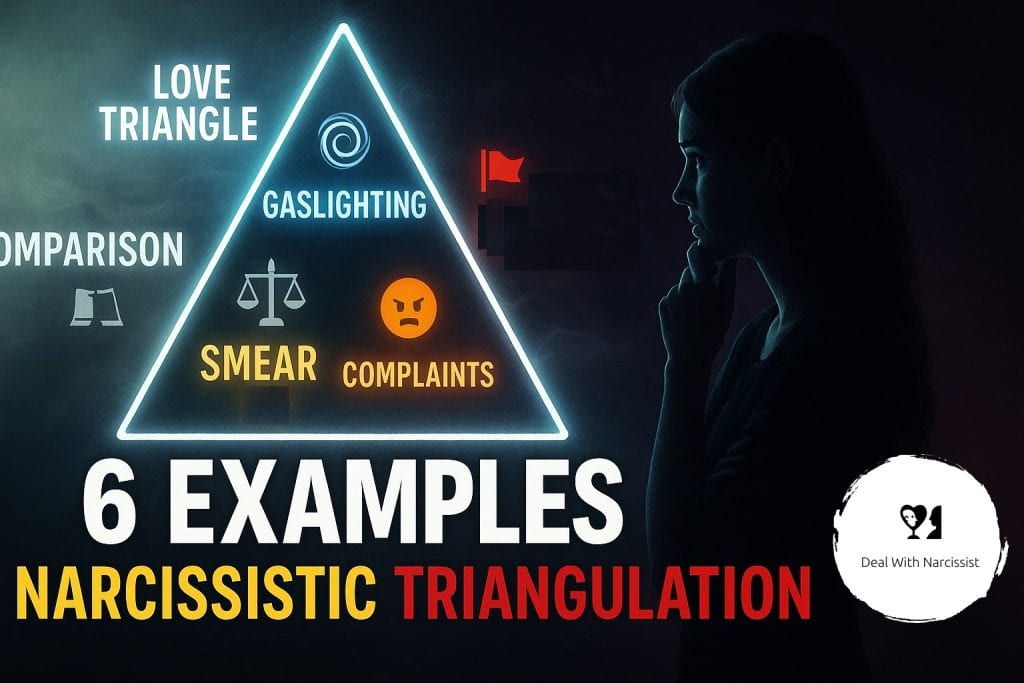
6 Real Examples of Narcissistic Triangulation
Triangulation can show up in many shapes and levels of intensity. Some forms look dramatic and obvious, while others are so subtle that you only notice the impact much later. Below are six real examples that show how this tactic works in everyday life and why it can be so destabilizing.
1. The Love Triangle
A narcissist may bring a third person into the dynamic, such as an ex, a coworker, or a friend, to trigger jealousy, tension, or emotional competition. They might casually mention someone flirting with them, compare you to others, or talk about how desirable or “popular” they are.
The goal is simple: make you feel insecure so you try harder. Your emotional reaction becomes supply for them.
Healthy people don’t enjoy making you uncomfortable. They don’t stir jealousy or use comparisons to control the relationship. Triangulation flips the dynamic so they take and you overgive, often without realizing it’s happening.
2. The Gaslighting Triangle
Here, a narcissist brings other people into the story to “prove” their version of events. They might gather allies, exaggerate details, twist context, or recruit so-called flying monkeys to pressure you into doubting yourself.
This can look like:
- “Everyone agrees you’re overreacting.”
- “My friends think you’re unstable.”
- “People at work said you’re the problem.”
- “The whole family says you’re wrong about this.”
Sometimes this escalates into a smear campaign. Other times it’s disguised as concern or praise. Either way, the goal is emotional pressure and control. It’s deeply destabilizing and often leaves the victim isolated or fearful of speaking up.
3. The Triangle of Comparison
This happens when the narcissist idealizes someone else in order to devalue you. They point out what others supposedly do better, how someone else “gets them,” or why another person is more impressive.
Examples:
- “Why can’t you be more like Sarah?”
- “My sister never complains.”
- “Lisa would never react like that.”
- “Your sister is very attractive, I didn’t know she was so beautiful.”
- “The sex was much better with my ex than with you.”
- “I love my mother, she is the best person I know. I wish you could be more like her.”
These comparisons aren’t innocent. They place you on unstable ground, push you into self-blame, and keep you striving for their approval and love. This approval and love is always conditional and always moving.
When someone uses comparisons to pull you down and lift someone else up, it’s part of a larger pattern. These shifts usually happen during the devaluing stage of the narcissistic abuse cycle, where the goal is to weaken your confidence and increase your dependence. If you want to understand how these stages work together, you can read my guide on the narcissistic abuse cycle.
4. Using a New Relationship to Smear or Hurt You
After a breakup or discard, a narcissist may involve a new partner in their attacks. This can include stalking, public shaming, provoking reactions, or using the new partner to message, confront, or monitor you.
It’s a way to punish, intimidate, or destabilize you while reinforcing their narrative that they are the victim. It’s also meant to pull attention and emotional energy back in their direction.
You don’t win by engaging with this. You win by stepping out of the dynamic entirely.
5. Creating Distance Between You and Someone You Trust
A common example is where a narcissist tries to create a distance between you and someone close to you, such as a friend or a family member. A narcissist may plant doubts, twist information, or stir subtle conflict between you and this person. They might complain about that person to you, and then complain about you to them, pushing both sides into defensiveness and confusion. Additionally, they can ask questions in such a subtle way you might think it’s your own opinion. You might not even notice their manipulation.
The result is a wedge. You withdraw. The other person withdraws. And the narcissist becomes the center point through which information, emotion, and connection must flow.
It’s a form of isolation disguised as “sharing concerns.”
6. Negative Interpretation and Complaining
This is a quieter but very common form of triangulation. A narcissistic parent, sibling, or partner might complain about you regularly to others. They interpret neutral events as negative, twist the meaning of your actions, and retell stories in ways that make you seem irresponsible, ungrateful, or uncaring.
Example: They say you “never call,” but when you do call, they shame you for calling too late, too early, or not enough. You are then supposed to feel guilty. If you point out they never call as well, they will likely go into a form of rage or being very offended. There is usually no proportion to this reaction.
They use the negative reaction they provoke in you as “evidence” to prove their narrative to others. It’s an emotional trap, and you can’t win by playing the game they set up. This is all about dramatic or negative interpretation of what happens and not taking any responsibility for themselves. It’s very easy to always make others responsible and never take any blame. It’s also very immature.
Real Dynamics Behind These Examples
The six examples above may look very different on the surface, but underneath them you’ll find a few repeating patterns. These patterns show how triangulation actually works in real life, and why it can be so confusing to spot. Understanding these deeper dynamics helps you see through the behaviour instead of getting pulled into the emotional pressure of it.
1. Subtle triangulation: when doubt slowly replaces trust
Subtle triangulation doesn’t rely on dramatic actions. It works through gentle questions, small comments, and repeated suggestions that make you second-guess someone you normally trust. The narcissist doesn’t openly attack the relationship. They slowly shift the meaning you attach to everyday interactions.
A simple example helps make this clearer. Imagine Emma, who has a close bond with her sister Monica. Emma’s partner keeps asking harmless-sounding questions like, “Has your sister called this week? I thought she would after your big job interview” or “Do you think she avoids telling you certain things? It almost feels like something might be wrong between you two.”
None of the comments are direct attacks. But over time, they plant doubt. Emma starts interpreting neutral actions in a negative way. Where she used to feel “I trust our connection,” she now feels “something is off,” and her mind begins to interpret everything through that new belief. This is how subtle triangulation works. The narcissist doesn’t destroy the connection themselves. They guide you to do it in your own mind.
2. Brutal triangulation: the smear campaign
This is triangulation at its most destructive. Instead of planting doubt subtly, the narcissist openly attacks your reputation, character, and emotional stability. They gather supporters to “confirm” their story, which creates outside pressure and can leave you feeling isolated or misunderstood. The emotional damage is deep because it targets your identity and social safety.
If you want to understand how the smear campaign works and why it’s so effective, you can read my in-depth guide on the narcissistic smear campaign. It breaks down the stages, patterns, and psychological impact so you can protect yourself with more clarity.
3. Conditional belonging: the golden child and scapegoat dynamic
In families, triangulation becomes part of the emotional structure. One child is idealized, the other is devalued, and both roles are used to maintain control. The golden child learns to stay in line to keep approval. The scapegoat learns to expect blame, even when they haven’t done anything wrong. This isn’t just poor parenting. It’s emotional conditioning. These patterns follow people far into adulthood and shape how they experience relationships, boundaries, and self-worth.
Triangulation doesn’t only happen between two people. In some environments it becomes the atmosphere everyone is expected to follow. This can happen in families with a dominant narcissistic parent or in workplaces with a narcissistic boss. Gossip, comparisons, loyalty tests, and subtle pressure create an unsafe culture where disagreement comes with consequences. Over time, the narcissist becomes the emotional center of the group, shaping how people relate to each other and controlling what is seen as “true”.
If this feels familiar, you may find more clarity in my guides on narcissistic parents, narcissistic siblings, and having a narcissistic boss.
Triangulation Is a Game of Truth
Triangulation works because it quietly rewrites the truth of a situation. It creates a version of reality where the narcissist is at the center, controlling what is shared, how it’s shared, and how it’s interpreted. When you’re in it, the tension you feel isn’t just emotional. It’s psychological. It’s the pressure of trying to make sense of stories that were never meant to be clear.
This is why triangulation often feels so personal. Your mind tries to find solid ground, but the narcissist keeps shifting the story. What they say, what they imply, and what they leave out all push you into doubt. Over time, it becomes harder to trust your own instincts because someone else keeps inserting themselves into your truth.
A helpful way to recognize the dynamic is to step back and look at the communication pattern. If someone seems to enjoy telling you negative information about others, keeps pulling you into drama, or becomes the “bridge” between people who should be speaking directly, it’s a sign something is off. A helpful saying here is: “What you say about other people says the most about you”. How someone speaks tells you something about their perception of others. In healthy dynamics, we usually see that:
- People who have good intentions don’t create confusion. They bring clarity.
- People who want harmony don’t add tension. They reduce it.
- People who respect you don’t block your relationships. They encourage healthy connection.
Pay attention to how someone makes you feel after you speak with them. Does your mind feel calmer, or more clouded? Do you feel more secure, or less? These emotional signals tell you more about the truth than their words ever will.
How to Spot These Patterns Sooner
Triangulation is often easiest to see in hindsight. When you’re in the middle of it, the shifts feel small, emotional, and personal. But once you know what to look for, the signs show up much earlier.
A few things often stand out:
- You feel more confused after conversations, not clearer. Healthy communication leaves you with understanding. Triangulation leaves you with tension, doubt, or pressure.
- Information comes “through” someone instead of directly. If someone regularly shares what others supposedly think, say, or feel about you, that’s a sign the triangle is forming.
- You start feeling differently about people you normally trust. If your view of someone shifts without any direct reason, ask yourself where that feeling began.
- You feel pulled into comparison. If you suddenly feel the need to prove your worth, defend yourself, or “compete,” it’s a sign someone is shaping the emotional tone.
These early signals aren’t dramatic, but they matter. Noticing them sooner helps you step back, reconnect with your own intuition, and protect your energy before the dynamic becomes damaging. If you want a deeper understanding of the psychology behind triangulation, why narcissists use it, and how to protect your energy, you can read my full guide: Narcissistic Triangulation: What It Is, Why They Do It, and How to Stay Grounded. This main article gives you the bigger picture so the examples make even more sense.
Final Thoughts (And Where to Go Next)
Seeing these examples laid out can be confronting, especially if parts of them feel familiar. Triangulation isn’t always loud or dramatic. Sometimes it’s quiet, subtle, and woven into everyday interactions. That’s what makes it so confusing. If you’ve found yourself caught in one of these dynamics, it doesn’t mean you missed something obvious or failed to protect yourself. It means the tactic worked the way it was designed to work.
What matters now is clarity: you’re already moving toward it. Every small step you take in the right direction is great!
If you’re dealing with someone who is using triangulation as part of a larger pattern of manipulation, you may also find these guides helpful:
- The full breakdown of the narcissistic abuse cycle
- How to rebuild self-worth after narcissistic abuse
- My free step-by-step guide From Fog to Clarity, if you want gentle guidance at your own pace.
Take your time with these topics. You don’t have to understand everything in one moment. Every bit of clarity you gain helps you step further out of confusion and back into yourself.
Agreed
the worst part of the smear campaign, is that it can be happening for YEARS before you realize it. You have no idea why people are behaving the way they are toward you, saying the things they are saying – and naturally, you respond with confusion, frustration, anger….which, unbeknownst to you, are serving to reinforce the smear. By the time you realize what’s been going on and maybe even who is behind it, it’s too late. The good part though, is it reveals the nasty characters of people who never deserved to be a part of your life in the first place.