Buddhism and Narcissism: What Buddhist Wisdom Can Teach You After Narcissistic Abuse
If you have experienced narcissistic abuse, you probably know how draining it is for your mind and energy. Narcissists can have a large impact on their environment by manipulating and trying to control their victims. You may be left with increased self doubts, low self worth, anxiety, and confusion.
In this article, I explore Buddhism and narcissism. I will not try to turn anyone into a Buddhist. Instead, I want to share how some Buddhist ideas about awareness, ego, silence, and compassion can support you when you are dealing with narcissists or recovering from them.
My own experience of having a father showing a lot of narcissistic behaviour pushed me, mostly unconsciously, toward Eastern philosophy. I found the wisdom in Buddhism soothing and helpful, especially the focus on looking inward instead of trying to fix everything outside. This will help in creating clarity. That is the reason I love to share some of these ideas with you.
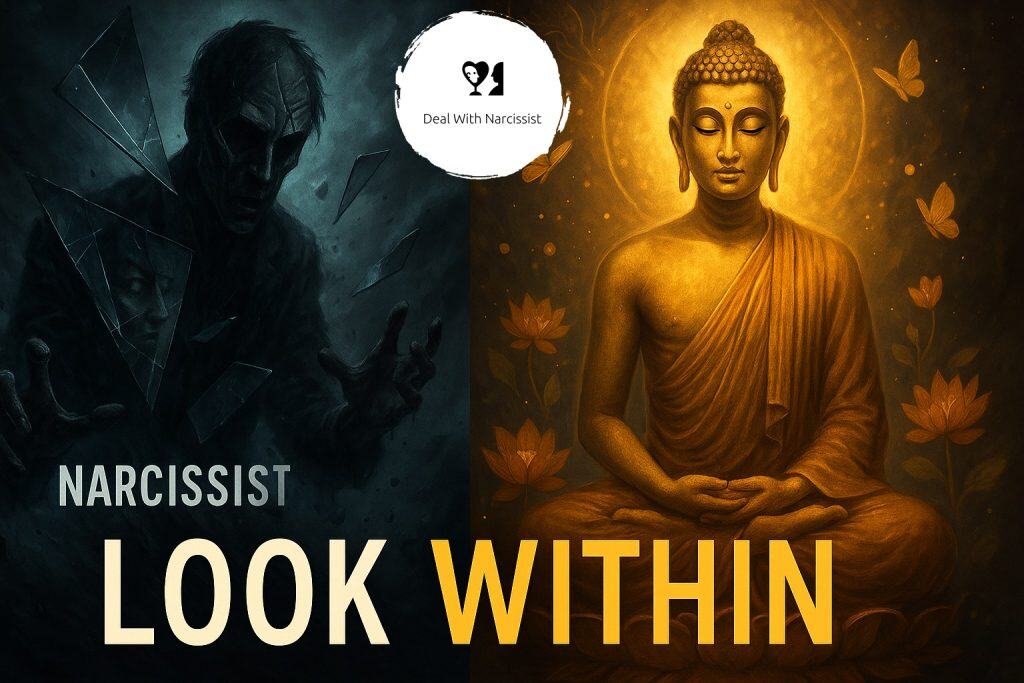
Sadly, many people experience narcissistic abuse. Dealing with narcissists is very personal and you have to learn how to deal with yourself and your mind. Buddhism can be one way to work on yourself if it resonates with you. A narcissist’s mind is mostly directed outward toward image, control, and validation. A Buddhist approach is directed inward toward awareness, honesty, and compassion. For me, this means a process of shifting the attention away from the narcissist and their world, and gently back to yourself.
The blind spot in the mind of a narcissist is honest self reflection. That blind spot is exactly where Buddhist practice begins.
I hope this article can be helpful to you in some way.
Buddhism in Short
I see Buddhism mainly as a philosophy and a way of looking at life. The teachings are based on the Buddha’s observations and insights. It’s not about believing blindly, but about self reflection and testing wisdom in your own experience. It’s an invitation to look inside ourselves.
At its core, Buddhism is about awareness. It’s about seeing reality as it is, before our thoughts, stories, and fears come in. The Buddha often summarised his teachings as being awake and aware of what is happening in the here and now.
To me, Buddhism in its purest form invites everyone to explore life by looking inside. The teachings are actually open to criticism. You are encouraged to examine them, not just accept them. The repeated message is that you have to research and discover everything yourself.
The Four Noble Truths
The Buddha’s teachings (Buddha-Dharma) urge you to focus on your own experience of ‘Truth” and not to become captivated by the doctrine itself. The reality of life is the problem that we don’t want to have any problems at all. Joy and sorrow, happiness and misfortune are simply a part of life. The essence of Buddha’s teachings can be summarised in the Four Noble Truths. Very shortly:
- The truth of suffering: suffering is part of human life and all around us.
- The truth of the cause of suffering: a lot of our suffering comes from within ourselves, from ignorance about how things really are and from wanting reality to be different (our desire to change reality).
- The truth of the end of suffering: we can understand how this extra suffering arises and we can work with it.
- The truth of the path: there is a way of living that supports this realization. This is called the Eightfold Path. This realization of ending suffering is called Nirvana (enlightenment).
For survivors of narcissistic abuse, this means: the pain of what happened is real, but there is also a second layer of suffering created by our own mind. This is a distinction between the pain and experience itself, and the extra suffering in your mind afterward. For example, constant self blame, replaying conversations, or hoping the narcissist will suddenly become a different person. Buddhist practice does not deny the first layer, but it helps to reduce the second layer.
The Eightfold Path
The Eightfold Path can feel like a long list at first, but it becomes much easier to understand when you look at it through the three basic aspects of Buddhist life. These three categories show how the mind, behaviour, and awareness are connected:
- Ethics / Morality: Right speech, right action, right livelihood
- Meditation and Mental Development: Right mindfulness, right effort, right concentration
- Wisdom: Right understanding, right thought
Seen this way, the path becomes more natural. It starts with ethics or morality: how you behave, speak, and live. When you try to act and live consciously, and choose not to harm others in doing so, your mind becomes calmer. A calmer mind makes meditation easier. Through meditation, you develop concentration and awareness. And from that awareness, wisdom slowly grows.
In other words, ethics support concentration, and concentration supports wisdom. It all works together.
The Eightfold Path is not about strict rules or perfection. It’s about seeing your suffering or “problems” clearly, noticing the patterns, and understanding how your way of living affects your inner world. When this becomes clearer, you naturally see the benefit of conscious living and being fully present.
In the end, the Buddha-Dharma tries to open our eyes to what we are experiencing right now. You don’t have to search outside yourself or depend on external things. It’s an internal process and a slow waking up in the here and now.
Thoughts, Feelings, and Emotions
Dealing with a narcissist can bring a roller coaster of thoughts and emotions. Their behaviour can emphasize emotions within yourself. It shows the importance of your mind in your experience of life. Buddhism also pays a lot of attention to this inner world.
A thought is a thought and a feeling is a feeling. You are not your feeling; you are aware of being aware of your feeling. Is there a need to attach to it? How do we decide this? From a Buddhist perspective, there are raw feelings and more complex emotions. Raw feelings can be pleasant, neutral, or unpleasant. Emotions are like mixtures built from these raw feelings. For example, fear can include unpleasant bodily sensations, thoughts about danger, and memories.
Our feelings and emotions strongly influence our behaviour:
- Directly, for example when you burn your hand and pull away.
- Indirectly, for example when you dislike someone and your mind starts collecting more and more reasons not to like them.
The mind tends to explain neutral events in a way that fits the story it already believes. It tends to align with your truth (your beliefs). So feelings influence thoughts, and thoughts then influence feelings again.
From a Buddhist view, some feelings are reliable and point to something true. Others are distortions. We feel their impact. Wisdom is learning to see which is which and deciding which feelings and thoughts to engage with. View feelings with discernment. This is what wisdom is in Buddhism.
How Narcissistic Abuse Distorts Your Inner World
This is where narcissistic abuse and Buddhism meet in a painful way. Narcissists disturb your natural process of acknowledging and observing your thoughts and feelings.
When you interact with a narcissist, the tendency is often to deny reliable feelings because they don’t match the narcissist’s “strong” version of the truth. Your intuition might say “something is off” while the narcissist insists that everything is your fault. To reduce the discomfort of this conflict your mind may twist itself into new explanations.
This is part of what is called cognitive dissonance. Your mind tries to reduce the gap between what you feel and what you are told. Defensive thoughts and unreliable feelings may grow, just to keep the narcissist’s story alive. Over time, you may even experience them as your own beliefs.
A narcissist uses manipulation and confusion to push you away from your own perception and into their world. Gaslighting is a clear example of this. Your mind can become trained in doubting yourself, blaming yourself, and ignoring your own warning signals.
From a Buddhist point of view, it becomes very important to rebuild the ability to observe your thoughts and feelings and to ask: “Is this really mine? Is this reliable?” Practices like meditation and conscious breathing can support this. If you feel anxiety, the discomfort could also point you towards a realisation something is off. It could be trying to tell you something. If you ask ”Why do I have this discomfort?” instead of ”How do I change this feeling or what should I do?”, it can help you realize it might be a warning signal from your intuition.
Ego, External Things, and the Narcissist’s “Truth”
The world of a narcissist is a world where external things and appearances are extremely important. There is an ongoing need for validation, admiration, and ego boosting. The identity of a narcissist is a fragile construction that depends on how others see them.
Ego is a created identity. It’s a derived sense of self, so it needs to attach to things outside itself: possessions, social status, work, abilities, education, physical appearance, relationships, belief systems, and so on. None of these things is your true self, but ego treats them as if they are.
Because ego is fragile, it lives in a state of fear. It constantly seeks more power, more control, and more confirmation. That is why a narcissist needs power over others. It’s not true strength. It’s dependence.
The Buddhist Mind: Turning Inward Instead of Outward
The Buddhist approach points in the opposite direction. It turns the mind inward instead of outward. It aims to gently loosen attachment to external things in order to gain insight and peace.
True power is within. Power over others is actually weakness pretending to be strength. Your deeper self does not need control, attachment, or constant validation to exist. It’s independent.
Being in the here and now is about letting these attachments loosen. Meditation and mindfulness naturally bring more presence into your life. Life is happening now. This present moment is where you can breathe, feel your body, and notice what is going on in your mind.
Fear, Narcissism, and the Future
Fear is a good example of how the mind quietly pulls you away from the present moment. Psychological fear often shows up as anxiety, tension, worry, or nervousness. It’s usually about something that might happen in the future, not about something happening right now.
Imagine walking on eggshells because you are afraid your partner will be angry when they come home. You are already tense and stressed before anything has actually happened. Your mind is trying to deal with an imagined future situation instead of the reality of this moment.
When you are dealing with a narcissist, this can become a daily pattern. You are always scanning for danger, replaying past conflicts, and trying to prevent future explosions. Your body is in constant alert.
Mindfulness does not magically remove the danger. It does help you notice when your mind has jumped into the future again. You can gently bring your attention back to your breath, your body, and the actual situation now. That is where your real choices live.
The Importance of Silence and Mindfulness
Thich Nhat Hanh describes the importance of mindfulness and silence like this:
“Silence is essential. We need silence, just as much as we need air, just as much as plants need light. If our mind is full of words and thoughts, there is no room for ourselves.”
He points to the very busy inner world many of us carry. Even when it’s quiet outside, our minds can be full of rumination and noisy thoughts. We chew on our worries like a cow chews its food. He emphasizes the positive effect of inaction and silence.
If you are in a relationship with a narcissist, you probably recognise this. You may feel confused, hopeless, ashamed, or doubtful. Your mind can feel like chaos and your energy is drained.
Practicing silence is a way to counterbalance this. That can be Buddhist meditation, simple conscious breathing, or other mindful methods. When you first sit in silence, your emotions may feel stronger. This can be overwhelming, but it’s not a bad sign. It means you are finally noticing what has been inside you all along.
If you push negative emotions back, they will stay in your heart. This will block your natural energy of joy and love. By acknowledging your emotions instead of pushing them away, you bring them into the light. You can allow and release them. This is healthier than carrying them unconsciously.
Meditation, Conscious Breathing, and Protecting Your Energy
Meditation is about letting go and practicing acceptance of the here and now. You try to let go of the outer noise so you can find some peace within yourself. You can see it as training your mind and gaining clarity.
Narcissistic energy is very involved in the world of ego and external things. Meditation and conscious breathing help you see more clearly and distinguish your own energy from the energy of others. This can be very helpful when you want to protect your energy after abuse.
Practicing meditation can be challenging, especially in the beginning, but there is no such thing as “bad” meditation. If you notice more noise, it simply means you are more aware. It can help to:
- Enjoy small moments of silence and simple breathing.
- Be patient and build up your practice slowly.
- Follow a method or a few simple steps that feel comfortable to you.
Being Kind and Compassionate to Yourself
I want to emphasise how important it is to be kind and compassionate to yourself. When you experience narcissistic abuse, your inner voice often becomes more harsh and negative. You don’t deserve this treatment, especially not from yourself.
You might start meditating because you feel stressed or anxious and you want to calm your mind. If you do, try to focus first on observing. Just see what is going on in your mind. Don’t try to force your thoughts away or tell yourself you are doing it wrong.
There is no need to drag the past into meditation, but if it comes up, that is okay. See yourself as a compassionate and kind observer, not as a judge. Allow yourself to sit, breathe, and simply be there.
Meditation and conscious breathing should be done with compassion and realistic expectations. This is what is meant by “right effort.” You cannot force yourself into the here and now. You can only invite yourself gently.
Ask yourself: what is possible for me at this moment? Maybe it’s two minutes of quiet breathing. Maybe it’s just noticing one harsh thought and saying, “I don’t have to talk to myself that way.”
Gentle Closing Thoughts
Buddhism in this context is not about strict rules or trying to become a perfect spiritual person. It’s about slowly taking your mind back from a painful experience. It’s about seeing more clearly what belongs to you and what belongs to the narcissist. It’s about learning to treat yourself with the same kindness you would offer to someone you love.
You don’t have to be perfectly calm. You don’t have to stop all thoughts. You only have to be willing to notice what is happening inside you and to take small steps toward more awareness, one moment at a time.
If you are interested in Eastern philosophies, you might also like my article exploring Taoism and narcissism.
Tremendous help! I just recently understood that I am in a narcissistic relationship. Previously all I felt was the pain and confusion of being in a dysfunctional relationship without the benefit of knowing what was behind it. When I got to understand my situation, I was at first relieved by the knowledge but lately the more I know about narcissism the more lost and desperate I get as it seems there’s no happy or tidy ending to being in a relationship with a narcissist. I have been practicing mindfulness for a couple of years now and thought I could find answers in the practice as well as in dharma. Your article has been very useful in affirming this. It has also provided me with some guiding beacons to use in navigating this rather treacherous territory of narcissistic relationships. Many thanks indeed.
Hi Charles, thank you for sharing and for your kind words. I’m grateful my article can be helpful to you. I’m sorry to hear about your experience. It’s very intense and disturbing to recognize this situation you’re in.
I hope practicing mindfulness will help you in providing clarity and that you will find the answers you seek within yourself. I wish you strength and kindness in the future!
Hi! Your article was impeccable! I also practice buddhism and have also suffered from narcissistic abuse. Buddhist practice saved my life. Please contact me I would love to ask you something! Thank you so much!
Hi and thank you very much. I’m just arriving and can already tell this is what I’ve been looking for. Blessings to you.
This is the first article I have read on Buddhism and Narcissism… I know I’m on the right path. Thank you for such an in-depth and we’ll explained article, it is very helpful.
Thank you for your kind response Terika. I’m glad it’s helpful to you. Wish you strength and kindness!