Can Narcissists Really Love? Conditional Love, Empathy, and What It Means for You
Questions about love and narcissism are very common if you loved a narcissist or grew up with one. You might wonder:
- Can a narcissist fall in love?
- Does my narcissistic parent love me?
- Was there ever any real love in my relationship or marriage?
These are not abstract questions. Very often, people ask them because they gave real love to someone who didn’t treat them with the same care. They usually come from pain and confusion. If you’re asking them, it often means you felt something that looked and sounded like love, but the reality of how you were treated does not match that picture. I’m sorry if you have gone through this or are in it right now. I hope this article and my website can give you clarity and support.
The short answer is not simple. Narcissists can show loving behaviour and may feel something they call love, but their love is conditional and limited by a lack of emotional empathy and conscience. In the end, the most important question is not only “Did they love me?” but “Is this what love is allowed to feel like for me?”
If you notice you’re reading this with a lot of emotion, that is normal. I will keep the language clear and grounded, so you can follow even if your mind feels tired or overwhelmed right now.
The Short Answer: Can Narcissists Love?
Let’s start with a clear statement: A narcissist can’t love in the same way you do if you have emotional empathy and a conscience. They can feel something they call love, but it’s conditional and tied to their needs, image and ego. It’s usually present when you fit their ideal, meet their needs or supply their ego, and it fades or flips when you no longer do.
They can feel attachment, desire, pride and even a kind of affection, but it’s conditional and always filtered through their own needs, self-image and ego.
This raises another question that is actually more important: if their behaviour drains you, confuses you, and disconnects you from yourself, does it matter what they call love? Or is it more important what you want love to mean in your life?
Different Forms Of Love (And Where Narcissists Fit)
Unconditional Love vs Conditional Love
Unconditional love is not perfect love. It does not mean there is never conflict or pain. It means there is a stable, deeper care for you as a person, even when you’re not useful, impressive, or pleasing. Your needs and feelings matter in their own right.
Conditional love says something like:
- I love you when you make me feel good about myself.
- I love you when you do what I want.
- I love you when you support my image and don’t disturb it.
This conditional form of “love” can feel very real at times, especially in the beginning, but it has a price. To keep it, you often have to lose pieces of yourself, silence your needs, and accept behaviour that hurts you.
Love, Love-Bombing, And Romantic Behaviour
There is another confusion that often appears in relationships with narcissists: the difference between real love and intense romantic behaviour.
Love-bombing is the phase in which a narcissist overwhelms you with affection, attention, promises and future plans. It can look like:
- constant compliments and admiration
- fast and intense declarations of love
- talk about a perfect future together very early on
- them saying you’re their soulmate or “the only one who truly gets them”
In this phase, they may honestly believe they are in love. You may feel more seen and cherished than ever before. The problem is that this love is not grounded in a real, stable connection with who you’re as a whole person. It’s often based on an idealized image and on what you give them.
Your Love For Them And Your Love For Yourself
Many survivors later ask themselves whether their own love was real. You might think: “If it was all manipulation, did I just imagine everything?”
Your love was real. The care you gave, the loyalty, the patience, the hope, the way you tried to see the best in them – that says something about you, not about them. It shows your capacity to love.
The tragedy is that this genuine love was poured into a system that could not truly return it. Narcissistic love is conditional. It’s given when their needs are met and withdrawn when they feel disappointed, criticized or bored.
My hope is that you will, step by step, learn to show that same loyalty and care to yourself. Your love is a beautiful thing. It deserves a healthier home.
How Narcissists Experience “Love”
Narcissistic love is conditional and self-focused. It often sounds like:
- I love how you make me feel about myself.
- I love that you do whatever I like and that you love me.
- I say “I love you” so you will stay, forgive, or give me what I want.
- I love the way you admire me when I say the right words.
A narcissist can “love” you because they love themselves and feel they deserve you as part of their image. You might improve their status, make them look good, or provide emotional, practical or financial support. They may enjoy parading you in public. In their mind, you can become another proof of their superiority.
For some narcissists, love is also mixed with practicality. Inside, they might be checking things like whether you’re a “good catch” for their image or status, how much money, success or social value you bring, whether you’ll keep admiring them, and whether you’ll stay and take care of them. When those boxes are ticked, they can feel very attached. When they’re not, their “love” often fades into irritation or coldness.
When these questions are answered with “yes”, they can feel strongly attached and invested. When the answers are “no”, their “love” often fades into coldness, irritation, or even cruelty. This setup is not stable and it’s not safe. You can’t be fully yourself and also keep their “love” at the same time.
Love-Bombing vs Real Love
Why The Beginning Felt So Intense
If you have been in a relationship with a narcissist, you might look back and remember how perfect it seemed at first. They were charming, attentive, deeply interested. It may have felt like they saw straight into your soul.
In the love-bombing phase, they can:
- tell you you’re the best thing that ever happened to them
- talk for hours about feelings, values and dreams
- mirror your interests and pain in a very convincing way
- promise a future full of commitment, support and safety
In those moments, they can genuinely think they feel love. You may also feel a very strong bond. The difficulty is that this “bond” is often more about fantasy, projection and their need for supply, and less about a slow, grounded knowing of who you are.
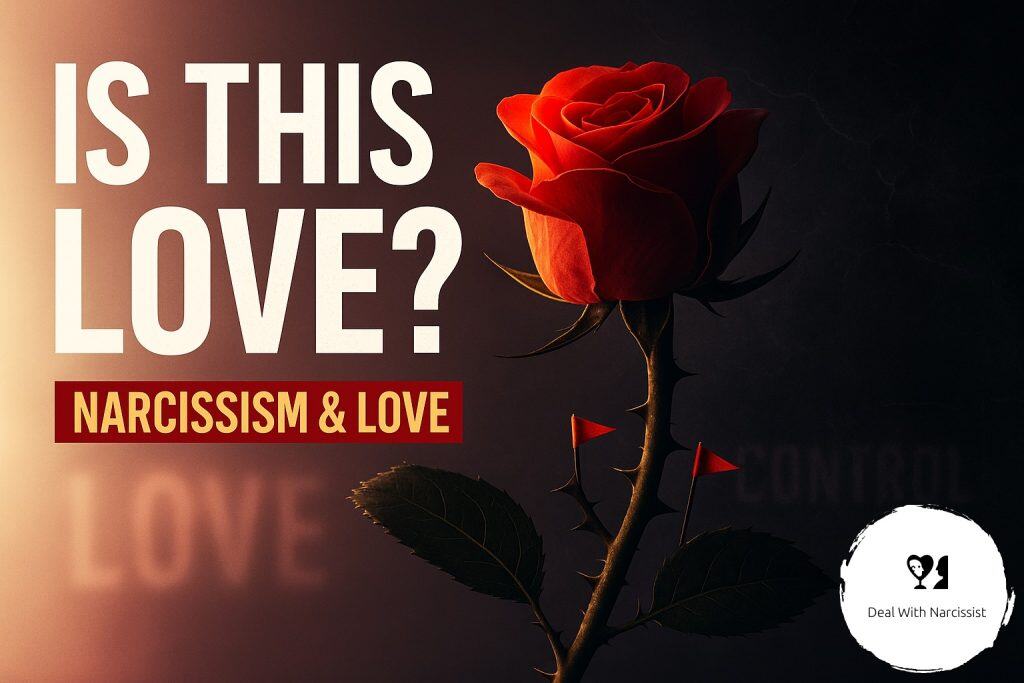
When Love Turns Into Control And Devaluation
Over time, something starts to change. Their “love” becomes less about connection and more about control. They may:
- withdraw affection when you set a boundary or disappoint them
- blame you for their moods and frustrations
- devalue qualities they first praised in you
- make you feel needy, too sensitive or not enough
You might then try to fix it by changing yourself. You may walk on eggshells, ignore your needs, or work harder to go back to the beginning. It’s very human to do this. The problem is that the shift is not about you suddenly failing. It’s about their conditional love running into reality.
Listening To Your Intuition In Hindsight
Many survivors say that if they look back honestly, their intuition spoke up early on. It might have felt:
- too fast, too intense
- like they loved you before they really knew you
- like something didn’t quite add up under the surface
You may not have been ready or able to listen then, and that is okay. When you’re healing, part of the work is to reconnect with that inner signal again and treat it with more respect next time. Your intuition is not perfect, but it’s not your enemy.
Empathy, Conscience, And The Limits Of Their Love
What Emotional Empathy Does In Real Love
Emotional empathy is what helps you feel with another person. When someone you love is in pain, you’re moved by it. You don’t just understand it in theory, you feel it in your body. Because of this, you’re less likely to deliberately harm them, lie to them, or use them as tools.
A healthy conscience adds another layer. It creates an inner limit. Even if you could get away with something in the outside world, your own inner sense of right and wrong stops you or makes you feel bad afterwards.
Narcissistic Lack Of Emotional Empathy
When someone has strong narcissistic traits or narcissistic personality disorder, this emotional empathy is limited or missing in important moments. They might understand your feelings in a logical way and can even describe them, but they are not guided by the same inner brakes.
Their world revolves around maintaining their self-image, seeking admiration and avoiding shame. They can say and do all the right things, but it does not have the same depth and consistency. It’s like a performance, not a deep, steady current.
If you’re an empath or a very sensitive person, this mismatch can be especially painful. You may feel very deeply and give a lot of unconditional love, while they respond from a much more self-centered place.
Conscience And Love: My Experience With A Narcissistic Father
For me personally, conscience was the key piece in understanding why real love was not possible with my narcissistic father.
At some point in my youth, I realized he did things I didn’t even know a human being was capable of, and then he could lie about it, deny it, and act as if it was completely normal. There was a huge gap between how disturbing his behaviour was and how calm and justified he seemed when he explained it.
That gap was eye-opening. It became clear to me that he didn’t experience a conscience the way I did. He knew the theory of what a good father should be. He could sometimes act charming, be involved, pay for things and do activities with us. But underneath that, his need for control, validation and ego-boosting was stronger than the role of “loving father”.
For me this meant there was no real foundation to build a deeper connection. For many survivors, this is the painful turning point: realizing that without honesty, conscience and empathy, there’s nothing stable to attach to, no matter how convincing the words sound. I could not trust his words because his behaviour kept showing something else. There was no stable truth to relate to. In the end, I had to accept that he didn’t have the capacity for unconditional love and emotional empathy in the way I needed it. That acceptance was painful, but it was also a turning point in letting go of false hope and protecting my own energy.
What About Narcissistic Parents: Do They Love Their Children?
This question can be very sharp: “Does my narcissistic mother or father love me?” It’s painful to even think it.
A narcissistic parent can provide food, clothes, a house, holidays, activities and sometimes even moments of warmth. They may say they are proud of you and show you off to others. It can look like love from the outside.
The difficulty lies in the pattern over time. When you look at your childhood as a whole, you might notice a pattern that feels something like this:
- your feelings were often minimized, ignored or mocked
- your needs were less important than their moods, image or comfort
- love and attention felt unstable and depended on how well you fit their expectations
In that sense, their “love” can be very real to them, but it’s still conditional and self-focused. Your experience of that love may be one of walking on eggshells, feeling invisible or feeling like you had to earn your place.
It’s understandable if you still want to believe they love you. You can hold compassion for what happened to them in their own life and at the same time be honest about the effect their behaviour has on you. Both can be true.
It’s Not Just “Did They Love Me?” – It’s “What Is Love To Me?”
After narcissistic abuse, many people stay stuck in the question “Was it ever real?” That question makes sense, but it can keep you circling around the narcissist for a long time.
A more helpful shift is:
- From: “Did they love me?”
- To: “Is this what I want love to feel like?”
You’re allowed to define what love means for you. For example, you might ask:
- Do I feel more myself in this relationship, or less?
- Do I feel safe being honest, or do I hide parts of myself to avoid conflict?
- When I’m in pain, does this person move toward me with care, or toward themselves with blame?
- If my best friend described this relationship to me, what would I honestly advise them?
Your answers may be uncomfortable, but they are also information. They tell you something about whether this love supports your life or slowly destroys it.
How To Start Healing If You Loved A Narcissist
Accept What They Can And Can’t Give
A painful but important step is accepting that you can’t create empathy in someone who does not have it. You can’t love a narcissist into becoming a different person. There is no magical amount of patience, understanding or self-sacrifice that will turn conditional love into unconditional love.
This does not mean you were foolish or weak. It means you were human, hopeful and loving in a place that could not fully receive it.
Rebuild Self Worth And Reconnect With Yourself
A narcissist often pushes you away from yourself. You may start doubting your own perception, your inner critic may become harsh and unforgiving, and you might even feel ashamed for staying or for how you reacted.
Self worth work here is not about forcing yourself to feel confident. It’s about slowly learning to relate to yourself in a kinder, more honest way again. That can look like:
- recognizing that your reactions made sense in the situation you were in
- allowing your emotions without judging them as “too much” or “not enough”
- noticing small moments where you act in your own best interest and giving yourself credit for them
When No Contact Is Not An Option Yet
Sometimes you can’t go no contact right away. You might share children, a workplace or a family system with the narcissist. In those cases, it can help to use temporary protection strategies.
One of those strategies is the grey rock method. It focuses on reducing emotional engagement so the narcissist gets less “supply” from you. You become more neutral and boring in your reactions. This does not fix the situation, but it can create a bit of space for you to plan your next steps.
True Love vs Conditional Love – What You Deserve
In the end, the core message is simple and painful at the same time: you can’t get healthy, unconditional love from someone who does not have the capacity for it.
A narcissist might care in their own way when their needs are met. They might miss you when you leave because their supply is gone. They might even feel hurt if you set boundaries. That feeling can be real for them, but it does not change the structure of the relationship. Their “love” still demands that you disconnect from yourself, cross your own boundaries, and make your life revolve around them.
You deserve more than that. You deserve a love where your feelings are taken seriously, where your growth is welcomed instead of punished, where you can be honest without fearing emotional destruction, and where you don’t have to constantly prove your worth just to be allowed to stay.
You’re allowed to ask yourself:
- What do I want love to feel like in my life?
- What kind of relationships do I want to build from now on?
- What small step can I take today that is a little kinder to myself?
It explains common patterns like hoovering, smear campaigns and the narcissistic abuse cycle, so you can feel more prepared.
You don’t have to figure everything out at once. You can start with small, gentle steps in your own direction: reading one helpful article, taking one conscious breath when your thoughts spiral, or writing down one quality you would like to see in your future relationships.
I hope this article brought some clarity about how narcissists “love” and why that love feels so different from what your heart is actually longing for. If you have a narcissist in your life, I hope my website and videos can support you in protecting your energy and slowly shifting your focus back to yourself.