Signs of a Narcissistic Parent: 12 Behaviours and How They Affect You
Growing up with a parent who behaves in narcissistic ways can quietly shape your whole inner world. You might grow up thinking their behaviour is normal and only much later realize how deeply it affected your self worth, your sense of safety, and how you show up in relationships.
Many people ask themselves questions like: “Do I have a narcissistic parent?” or “Am I overreacting, or was this actually unhealthy?” It’s very common to doubt yourself, especially if you were trained from a young age to think about your parent’s needs before your own.
In this guide I focus on behaviour, not diagnosis. I can’t diagnose anyone and I don’t see people as fixed labels. When I use the word “narcissistic” here, I’m talking about patterns of behaviour that are manipulative, self centered, and emotionally immature, not about someone’s worth as a human being.
As the child of a father who showed a lot of narcissistic behaviour, I know how confusing and lonely this can be. My goal with this article is to describe the dynamics honestly so that if you recognize parts of this in your own story, you can feel less alone and more clear about what you’re dealing with. From there, you can slowly shift the focus back to yourself, your needs, and your energy.
If you want to read more about my own experience, you can also read my article Growing Up With a Narcissistic Father: 9 Lessons About Self Worth, Family, and Boundaries.
What Narcissistic Behaviour in a Parent Looks Like
Narcissistic behaviour is often marked by a lack of empathy, a strong hunger for admiration and validation, an inflated ego, and a deep need to control how others see them. In a parent, this can show up in many ways. Their needs and image come first. Other people, including their children, often end up playing a role in that image.
It’s important to say clearly that anyone can show narcissistic behaviour sometimes. Having a selfish moment doesn’t make someone a narcissist. What really matters is the pattern, how often it shows up, and how it affects the people around them.
Some parents occasionally act in a self centered way, then reflect, apologize, and try to do better. Others show a repeating pattern of manipulation, denial, and emotional immaturity. They don’t take responsibility for their impact and expect everyone else to adapt. It’s that long term pattern that can be deeply harmful for a child.
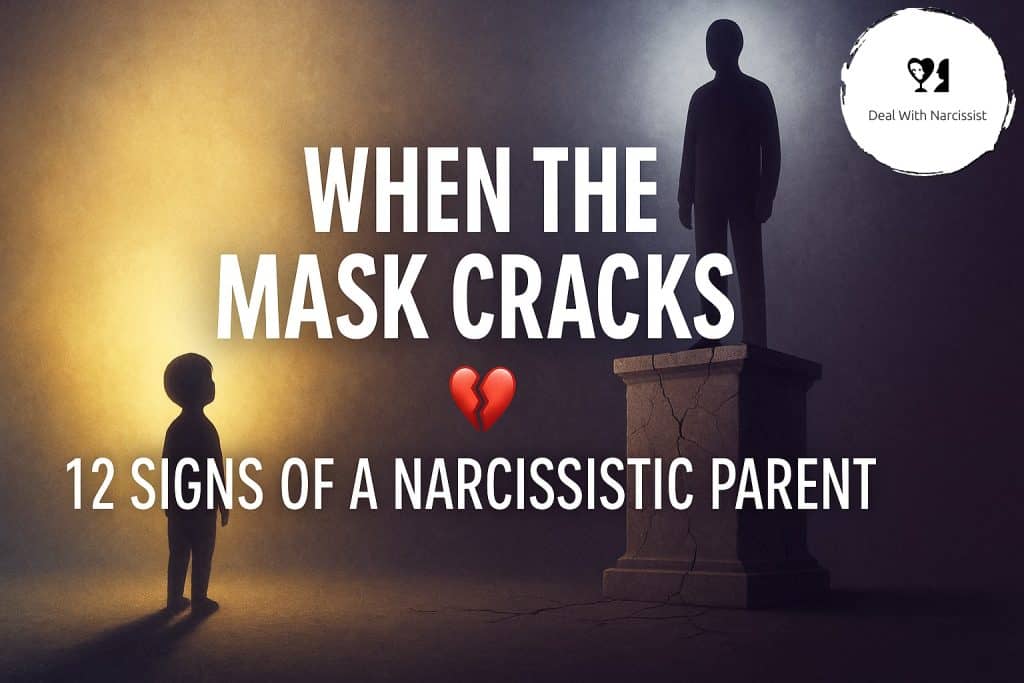
This is why I focus on behaviour instead of labels. In daily life, you have to deal with what is being shown, not with the word used to describe it. Children who grow up with narcissistic behaviour usually adapt in order to feel as safe as possible. Many of them learn to wear a mask. They become experts at keeping the parent calm, reading the room, and changing themselves to match what is expected. Their own feelings and needs move into the background. This can lead to identity questions later on. You may wonder who you really are when you’re not in survival mode.
If you recognize some of this, you’re not imagining things and you’re not too sensitive. These are normal reactions to an environment where your inner world wasn’t fully seen.
In the next part, I’ll walk through twelve common patterns that often show up in narcissistic parenting. Try not to focus on single details. Instead, gently look at the overall pattern, how it feels, and how long it has been there for you.
 .
.12 Signs of a Narcissistic Parent
Before we go through the signs, a small reminder. One single sign on its own doesn’t prove your parent is narcissistic. It’s the overall pattern, the intensity, and how you feel in the long term that matters most. Use this list as a way to reflect on your experience, not as a strict checklist.
1. They Try to Live Their Dreams Through You (The Trophy Child)
Some narcissistic parents treat their child as a project. They push you in a certain direction because it fits their dream, not necessarily yours. This can be a sport, a hobby, a study path, or a career. You might hear stories about how they never had the chance to follow their talent, how life or other people held them back, and how now you have that chance.
In this dynamic, your achievements are not fully yours. If you succeed, it’s because of their genes, their guidance, or their sacrifices. If you struggle or fail, it’s because you weren’t capable enough or didn’t try hard enough. You might not even remember choosing this path yourself. It simply became “what you do”.
Over time, this can make it hard to know what you actually like or want. You might feel guilty for wanting something different, or selfish for stepping away from their dream. It can also create a deep fear of failure, because failing doesn’t feel like a normal part of learning. It feels like letting them down and losing their approval.
2. Your Success Belongs to Them, Not to You
Many parents feel proud when their child does well. That’s normal. With a narcissistic parent, something else is going on. Your success becomes a mirror for their ego. It’s used as proof that they’re special, talented, or important.
You might notice that when you receive a compliment, the conversation quickly turns toward them. Your good grade becomes proof of their intelligence. Your promotion becomes a story about how they raised you. Your achievement is told as their achievement. There’s very little space for you as a separate person who built something through your own effort and choices.
This can make your own growth feel strangely empty. You’re doing well, but it doesn’t land deeply inside you. It’s almost as if you’re performing for their image, not living your own life. That can create a quiet sadness, even when things look “successful” from the outside.
3. Conversations Somehow Always End Up Being About Them
If you grew up with narcissistic behaviour, you might have noticed that the attention tends to flow in one direction. You can start talking about your day, your thoughts, or your feelings, and somehow the focus shifts back to your parent. They tell a bigger story, a similar story, or simply change the subject to themselves.
You can share something vulnerable and be met with comparison, minimization, or a story about how much harder they had it. You can share something joyful and suddenly find yourself listening to their achievements. It’s subtle sometimes, but the pattern is clear. There’s very little space to stay with your experience.
When this happens over and over, it teaches you something. It tells you that your inner world is not really a place of interest. You may stop sharing. You may become very selective and controlled about what you say. Or you might share and walk away feeling unseen, as if your words disappeared into the air.
4. They Put You Down When You Shine
A narcissistic parent can be proud of you in one moment and strangely threatened the next. When your growth starts to challenge their sense of superiority, they may respond with small cuts instead of support.
You might notice negative jokes that don’t feel playful at all, small comments that question your abilities, or stories that highlight your mistakes instead of your efforts. When you’re excited, they may cool you down with criticism. When something goes well, they may quickly point out what could have been better.
This can be confusing, especially if they also encouraged you to do well. It sends a mixed message: you’re expected to succeed, but not allowed to truly shine. Success becomes emotionally dangerous. Many people respond by shrinking their own light, holding back, or sabotaging opportunities without fully understanding why.
5. They Smear or Devalue Others to Feel Superior
A common pattern in narcissistic behaviour is talking about others in a harsh and dismissive way. A narcissistic parent might be very charming to someone in person, then speak about them with contempt when they’re not there. People are put into simple categories in their mind: useful and admirable, or foolish and beneath them.
You may hear them mock relatives, neighbors, coworkers, or even their own friends. They can present themselves as the only one who really understands, the only one who is truly capable, and everyone else as weak, stupid, jealous, or dramatic. Sometimes this escalates into full smear campaigns, especially when someone sees through their behaviour or refuses to play along. That person suddenly becomes “crazy,” “ungrateful,” or “toxic,” and your parent may try to pull others into that view.
As a child, this teaches you that love and respect are not stable. People can be praised one day and torn down the next. It can make you very careful about what you say and do, because you know how quickly someone can be turned into the enemy in their story. If you want to understand this more deeply, you can read my guide on the narcissist smear campaign.
6. They Show You Off in Public as Part of Their Image
On birthdays, family gatherings, or social events, your family may have looked happy and successful. A narcissistic parent often cares a lot about how things appear from the outside. You might be asked to dress a certain way, behave perfectly, and present a polished picture.
The focus in those moments is not on how you feel, but on what you represent. You become part of the set. Your role is to confirm the story they want others to believe: that everything is fine, that they’re a great parent, that the family is doing well.
Meanwhile, the atmosphere at home may be tense, cold, or chaotic. That split between what is shown and what is felt can be very painful. It can leave you with a deep sense of loneliness, because even when you’re surrounded by people, the truth of your experience is hidden.
7. They Use Guilt, Shame, and Pressure to Control You
Manipulation is often a core part of narcissistic dynamics. A parent can use guilt to remind you of everything they did for you, blame to make you responsible for their unhappiness, or shame to cut into your self worth when you don’t live up to their expectations.
It can sound like “after all I have done for you,” “because of you my life turned out like this,” or “you’re such a disappointment.” They may compare you to siblings, cousins, or others in a way that makes you feel small. They may also pressure you with threats about money, support, or contact if you don’t follow their wishes.
When love and approval feel conditional like this, it creates a constant feeling of walking on a tightrope. You’re always trying not to fall. Over time, you may stop making choices based on what you want and start making choices based only on what will keep them calm. If you want to understand these patterns in a wider context, you can read my guide on narcissistic manipulation tactics.
8. They Act Childish, Jealous, or Competitive With You
Sometimes, the narcissistic parent is the most childish person in the house. They can become jealous when you get attention, sulk when things don’t go their way, or compete with you instead of supporting you.
You may have moments where your parent behaves more like a sibling than a stable adult. They might need constant praise for simple tasks. They might insist that you watch them, listen to them, and admire them, turning even small activities into a performance that must be appreciated.
This can create a strange role reversal. You end up managing their emotions, calming them, and adjusting yourself to keep them stable. Instead of being taken care of, you’re pulled into taking care of them. That can make you grow up very quickly on the outside, while carrying a lot of unresolved fear and sadness on the inside.
9. Their Reactions Are Tense, Touchy, and Unpredictable
Many people who grew up with narcissistic behaviour remember specific moments where a small thing led to a big reaction. You might knock on the door at the “wrong” time, ask a simple question, or interrupt without knowing it was a bad moment. The response can be anger, shouting, heavy sighing, or a long cold silence.
As a child, you don’t have the context to understand that this is about them and their inner world. You simply feel the impact. If this happens often, your nervous system adapts. You start to scan for danger constantly. You rehearse what you want to say. You try to be invisible at the right times.
That kind of tension can stay in the body for many years. Even as an adult, you may feel a sudden rush of anxiety when you have to “disturb” someone, ask for help, or bring up a normal need. Your reaction isn’t irrational. It’s shaped by a past where small steps could have big emotional consequences.
10. Your Feelings Are Ignored or Dismissed (Lack of Empathy)
A lack of empathy is one of the most painful parts of narcissistic behaviour. With a parent, this can look like never asking how you are, changing the subject when you express emotions, or telling you that you’re overreacting, dramatic, or too sensitive.
Your inner world is not met with curiosity or care. It’s treated as irrelevant or inconvenient. You may also see this lack of empathy in the way your narcissistic parent treats the other parent. They can make cutting jokes at their expense, dismiss their feelings in front of you, or treat them with a harshness that leaves you feeling unsettled.
When your emotions are repeatedly ignored or twisted, you may learn to ignore them yourself. You might lose touch with what you feel. You may also doubt whether your reactions are valid, because you were never shown that your inner world mattered.
11. They Create Unhealthy Dependency (Emotional or Financial)
Some narcissistic parents want their children to remain dependent, even as adults. They might discourage you from moving out, building your own relationships, or making independent choices. Help and support can come with strings attached. You may feel that you owe them loyalty, time, or obedience in return.
This can show up emotionally, where you’re expected to be their main source of comfort and validation. It can also show up practically, where money, housing, or other forms of support are used as a way to keep you close and under control.
It’s not wrong for families to support each other. The difference here is that your needs come second. Your life is bent around keeping the parent comfortable. When you try to create some distance, you might be met with guilt, anger, or threats of withdrawal.
12. Or They Go the Other Way: Emotional Neglect and Disinterest
In some situations, the narcissistic parent is simply not interested in their child beyond a superficial level. If you don’t give them the attention or admiration they want, they may focus completely on their own life, work, hobbies, or other relationships.
You might have had food, clothes, and school, but very little emotional presence. Your feelings, thoughts, and struggles didn’t seem to land anywhere. It can even feel like you were growing up next to them, but not with them.
Emotional neglect is often quiet, which can make it hard to recognize. There may not be big fights or dramatic scenes. There’s just a lack of warmth, curiosity, and emotional contact. This can leave a deep sense of emptiness and a quiet question: “Was I ever truly wanted?”
If you see yourself in several of these signs, it doesn’t mean you’re broken. It means you adapted to a difficult environment. You can now begin to understand the pattern and, slowly, choose something different for yourself.
How These Patterns Affect You as a Child (And Later as an Adult)
Narcissistic behaviour in a parent doesn’t stay in the past once you move out. It tends to echo through your inner world in different ways. None of what I describe here is a flaw in you. These are understandable responses to the environment you grew up in.
Many people carry a deep layer of self doubt. When your reality was questioned, minimized, or twisted for years, it makes sense that you doubt your memories and feelings now. You may go back and forth between “it really was that bad” and “maybe I’m exaggerating”. This mental swinging is part of what is called cognitive dissonance. If you want to explore that more, you can read my article on cognitive dissonance in narcissistic abuse.
You might also notice strong people pleasing patterns. When conflict with a parent felt dangerous, your nervous system learned that keeping others calm is the safest option. As an adult, you may say yes when you mean no, over explain yourself, or feel a lot of anxiety when someone is disappointed.
Another common effect is a distance from your own needs and feelings. You became very skilled at sensing what others want and feel, but you may struggle to answer simple questions like “what do you need right now?” or “what would you like?” It can take time to rebuild that inner connection, because you were never encouraged to look there.
Boundaries can feel complicated as well. When you tried to set limits with your parent, you might’ve been punished or guilted. Now, even healthy boundaries can feel “wrong” or selfish. You might feel guilty for needing space, even when that space is necessary for your well being.
On top of all this, there’s often a quiet layer of shame. Children naturally blame themselves for their parent’s behaviour, because the idea “I’m the problem” feels safer than “the person I depend on can’t love me in a healthy way.” That self blame can turn into a deep belief that something is wrong with you at your core. It’s not true, but it can feel very real.
The good news is that these patterns are not who you are. They’re learned reactions. With awareness, compassion, and support, you can gently unlearn them and build a life that doesn’t revolve around someone else’s pain.
What to Do If You Recognize These Signs
Realizing that your parent shows narcissistic behaviour can be a big emotional moment. It can bring relief, sadness, anger, and grief all at once. You don’t have to change everything in one day. Healing is more like a series of small, honest steps.
Start by Validating Your Own Experience
The first step is to gently believe yourself. For a long time, you may’ve been told that you were too sensitive, dramatic, or ungrateful. Many children in these dynamics learn to distrust their own perception. It can be powerful to slowly turn that around.
You might remind yourself that what you felt as a child was real, that your fear or confusion made sense in that situation, and that your body and emotions were giving you honest feedback about the environment you were in. Writing things down, talking to someone safe, or working with a therapist can help you see the pattern more clearly.
Shift Attention From Their Behaviour to Your Healing
It’s very normal to spend a lot of time thinking about your parent. You might want to understand why they’re like this, whether they’ll ever change, or what you could say to finally make them see. At some point, it can be more healing to start asking different questions.
You might slowly move from “why are they like this?” to “how has this affected me?” and “what do I need now?” You can’t repair someone else’s inner world. You do have influence over how you treat yourself, what you allow into your life, and how you respond to your own pain.
This shift isn’t about blaming you. It’s about giving you a sense of direction. Your energy is limited. Spending it all on trying to change or understand your parent usually leads to exhaustion. You can’t change their behaviour and you’re not responsible for it. Spending it on your own healing, step by step, can lead to real change.
Create Emotional and Practical Boundaries
Boundaries are simply limits that protect your energy and your well being. With a narcissistic parent, boundaries might mean choosing not to engage in certain conversations, stepping away when the manipulation cycle starts, or limiting how much personal information you share. It can also mean protecting yourself practically, for example around money or living situations, so that support is no longer a tool of control.
In some cases, emotional distance or low contact becomes necessary. In other cases, small adjustments already make a difference. Every situation is unique. What matters is that you listen to how your body and mind respond after contact. If you regularly feel drained, guilty, or shaken, it’s a sign that stronger boundaries could be helpful.
Seek Safe Support and Reality Checks
Healing from a narcissistic parent is heavy to carry alone. It can make a big difference to have at least one person who sees you clearly and doesn’t twist your experience. This could be a trusted friend, a partner, a sibling, or a therapist.
Talking with someone who understands these dynamics can help you release the idea that you’re exaggerating. It gives your nervous system a chance to experience what healthy listening feels like: someone staying with your story, not making it about themselves, and not questioning your reality.
If you want structured professional support, therapy can be a gentle place to reconnect with yourself. If you prefer online, I personally recommend the platform Online-Therapy.com, which offers licensed therapists and a calm space to explore your patterns at your own pace.
🌼 Find a licensed therapist online →
(By using my affiliate link you’ll receive a 20% discount off your first month with code THERAPY20.)
Let Go of the Fantasy of a Different Parent
One of the hardest parts of this process is gently grieving the parent you didn’t have. Many people carry an inner image of who their parent could one day become. They hope for an apology, a moment of real empathy, or a complete change of heart.
Sometimes small changes happen. Often, the deep pattern stays. Letting go of the fantasy doesn’t mean you have to hate your parent. It means you stop building your life around the hope that they’ll one day become someone they haven’t shown themselves to be.
This can be painful at first, but in time it brings more peace. It allows you to stop waiting at a door that doesn’t open and start walking into your own life. You can still feel sadness and compassion. You can also choose to give yourself now what you didn’t receive then: care, protection, and emotional honesty.
Frequently Asked Questions About Narcissistic Parents
1. Can a parent be narcissistic with one child but not the others?
Yes, that can happen. Many families have different “roles” for each child. One might be treated as the golden child, who’s idealized and used as proof of the parent’s greatness. Another might be the scapegoat, who receives most of the criticism and blame. The same parent can behave very differently toward each child. This can create tension and confusion between siblings, especially when one child’s experience is minimized because “they’re always treated so well.”
2. Is it possible my parent is just self centered and not narcissistic?
It’s possible. People can be self focused or emotionally unaware without having a full narcissistic pattern. The exact label is less important than how the behaviour affects you. A useful question is: “Do I generally feel safe, seen, and respected, or do I often feel drained, guilty, and invisible?” Your nervous system and your emotional reactions give you important information, regardless of which word you use for your parent.
3. Can a narcissistic parent ever change?
Change is only realistic when someone is willing to see their own behaviour, feel the discomfort of that, and take responsibility over time. Strong narcissistic patterns make this difficult, because admitting fault threatens their self image. Some parents may soften in certain areas or improve certain behaviours, but it’s rare to see a complete shift without deep inner work. It’s important not to base your whole life on the hope that they’ll become completely different. You can wish them well and still focus your energy on your own healing.
4. Do I have to cut contact to heal?
Not everyone needs or wants to go no contact. Some people choose low contact, with strong emotional boundaries and clear limits. Others keep surface level contact and do more internal work on detaching. In some situations, full no contact is the healthiest option. There’s no single right answer. What matters is that you’re honest with yourself about how contact affects you and that you allow yourself to choose what supports your mental and emotional health, not what keeps the image of a “good child” intact.
5. How do I stop feeling guilty for pulling back or setting boundaries?
Guilt is very common, especially if you were raised to believe that your main job is to keep your parent happy. It can help to remind yourself that caring for your own well being isn’t a betrayal. It’s an act of responsibility. You can hold two truths at once. You can wish your parent well and also choose distance when their behaviour harms you. As you see how boundaries create more calm and clarity in your life, the guilt often becomes softer and is slowly replaced by quiet self respect.
Gentle Next Steps (If You Are Ready)
You don’t have to process everything in this article today. You can take it in slowly, return to it later, and choose one small next step that feels supportive instead of overwhelming.
If you want to keep exploring, you may find these guides helpful:
- My personal story and what I learned from my father’s behaviour: Growing Up With a Narcissistic Father: 9 Lessons
- Seeing the wider system of tactics at play: Narcissistic Manipulation Tactics
- When a brother or sister shows similar behaviour: Narcissistic Siblings
- Rebuilding your inner foundation and sense of self: Rebuilding Self Worth After Narcissistic Abuse
- A gentle step by step start if everything still feels foggy: my free e-book “From Fog to Clarity”
You’re not responsible for the behaviour of a parent who couldn’t face their own pain. You are responsible for how you care for yourself now. That responsibility is not a burden placed on you by others. It’s a form of power. It’s about taking charge. It means you’re allowed to make choices that protect your heart, your energy, and your future.
You’re allowed to build a life that doesn’t revolve around their moods, their expectations, or their wounds. You’re allowed to create relationships that feel steady, kind, and real.